

| Midcentury Modern era | Approximately 1940s-1960s |
| Japandi origin | Blend of Japanese and Scandinavian design principles |
| Key Scandinavian concept | Hygge - warmth, coziness, and comfort |
| Modern vs. contemporary | Modern = early 20th-century movement; contemporary = current trends |
| Industrial design hallmarks | Exposed brick, raw concrete, metal, reclaimed wood |
| Bohemian defining trait | Layered global textiles, mixed patterns, abundant plants |
Why Design Styles Matter (Even If You're Not a Designer)
Interior design styles are shorthand - shared visual languages that make it easier to describe, identify, and intentionally mix the elements of a room. Knowing the basics doesn't require formal training. It simply gives you a clearer vocabulary when you're arranging a living room, shopping for furniture, or trying to understand why a space feels cohesive or chaotic.
This reference covers the most widely recognized styles in American homes today: what defines each one, the visual cues that signal it, and how to recognize it in real rooms. For readers working with tighter square footage, these principles also connect directly to space-efficiency strategies - see our guide to small-space design for layout and lighting ideas that work across styles.
| Midcentury Modern era | Approximately 1940s-1960s |
| Japandi origin | Blend of Japanese and Scandinavian design principles |
| Key Scandinavian concept | Hygge - warmth, coziness, and comfort |
| Modern vs. contemporary | Modern = early 20th-century movement; contemporary = current trends |
| Industrial design hallmarks | Exposed brick, raw concrete, metal, reclaimed wood |
| Bohemian defining trait | Layered global textiles, mixed patterns, abundant plants |
The Major Interior Design Styles at a Glance
Midcentury Modern
Rooted in American design from roughly the 1940s through the 1960s, midcentury modern is defined by clean horizontal lines, organic curves, and a deliberate connection between indoors and outdoors. Furniture sits low to the ground, legs are tapered and exposed, and materials include teak, walnut, molded plywood, and fiberglass. Color palettes lean toward warm neutrals accented with mustard, olive, or burnt orange. Clutter is minimal - each object earns its place.
Scandinavian
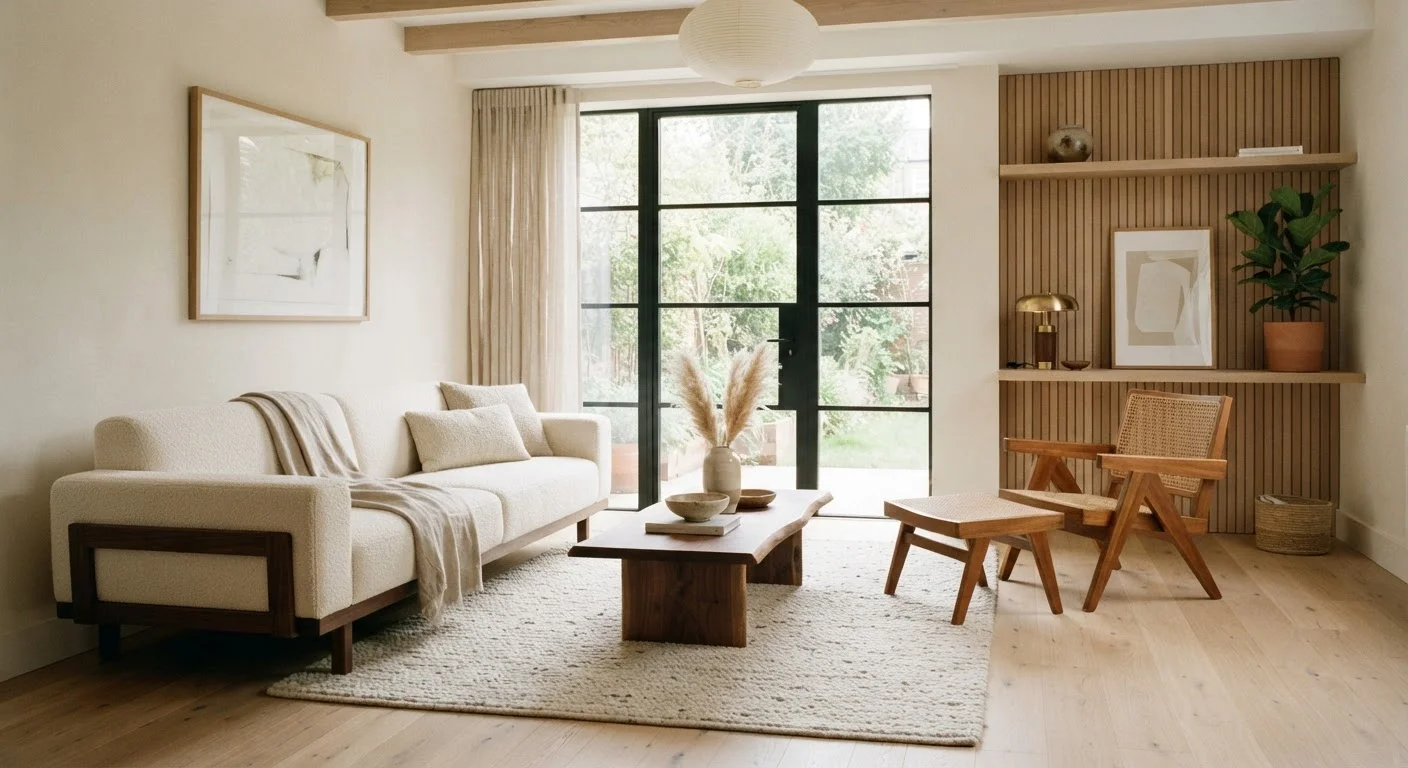
Scandinavian design prioritizes function, simplicity, and comfort in equal measure. Rooms feel calm and uncluttered, with white or pale gray walls, natural wood, and textiles like wool and linen adding warmth. The concept of hygge - a Danish and Norwegian idea roughly translating to coziness and contentment - runs through the style. Lighting is carefully considered, often layered with candles and ambient fixtures to compensate for limited natural daylight in Nordic climates.
Japandi
Japandi is a design hybrid that blends Japanese wabi-sabi philosophy - finding beauty in imperfection and impermanence - with Scandinavian functionalism. The result is spare, grounded, and deeply intentional. Expect muted earth tones, handcrafted ceramics, natural fibers, and furniture with strong, simple silhouettes. Unlike sterile minimalism, Japandi rooms feel lived-in and human. For readers who love neutral rooms, designing with a tonal palette explains how to add depth without adding color.
Industrial
Industrial style draws directly from converted factories and urban lofts: exposed brick, raw concrete, steel beams, and ductwork left visible as design features rather than hidden. Furniture tends to be substantial - leather, reclaimed wood, metal - and the overall mood is masculine and utilitarian. Warmth is introduced through Edison-bulb lighting, vintage rugs, and aged-wood accents.
Bohemian
Bohemian (or boho) interiors reject strict rules in favor of layered global textiles, mixed patterns, vintage finds, and abundant plants. Rooms feel collected over time rather than designed in a single pass. Color is rich and varied - jewel tones, terracotta, and natural indigo often appear together. The style rewards personal expression and is among the most forgiving for budget decorating.
Traditional
Traditional design draws on European, particularly English and French, decorating conventions: symmetrical furniture arrangements, rich fabrics like damask and velvet, dark wood finishes, and formal architectural details including crown molding and wainscoting. Patterns such as florals, plaids, and stripes appear frequently. Rooms feel formal and polished rather than casual.
Contemporary vs. Modern
These two terms are often used interchangeably but mean different things. Modern refers to the early-to-mid 20th-century movement defined by the Bauhaus and related schools - form follows function, ornament is eliminated. Contemporary simply means what is current right now, and it shifts constantly. A contemporary room in a given decade might incorporate curves, color, or ornamentation that a strict modernist would reject.
Wabi-sabi
A Japanese aesthetic philosophy that finds beauty in imperfection, impermanence, and incompleteness. In interior design, it translates to handmade objects, natural materials with visible grain or texture, and an absence of rigid symmetry.
Hygge
A Danish and Norwegian concept describing a quality of coziness, warmth, and convivial comfort. In Scandinavian interiors, it is achieved through soft lighting, natural materials, and inviting textiles rather than visual complexity.
Bauhaus
A German art and design school (1919-1933) that championed the idea that form should follow function. Bauhaus principles are a direct ancestor of modern interior design, emphasizing geometric shapes and the elimination of decorative ornament.
Tonal palette
A color scheme built from variations of a single hue or a family of closely related hues, differentiated by lightness and saturation. Tonal rooms feel calm and unified without being monotone.
Wainscoting
Decorative wood paneling applied to the lower portion of an interior wall, typically capped with a horizontal molding rail. Common in traditional and transitional design styles.
Japandi
A hybrid design style combining Japanese minimalism and wabi-sabi philosophy with Scandinavian functionalism and warmth. The result prioritizes natural materials, muted tones, and purposeful simplicity.
Mixing Styles Without Losing Coherence
Most real homes don't fit neatly into a single style - and they don't need to. Designers frequently mix influences, anchoring a room with one dominant style and using a secondary style as an accent. A Japandi foundation, for instance, can absorb a few bohemian textiles without losing its calm. A midcentury modern frame handles industrial metal accents cleanly.
Two practical principles help keep mixed styles from feeling chaotic. First, maintain a consistent color story - a limited, intentional palette ties disparate pieces together. Second, vary texture rather than pattern; too many competing prints fragment visual attention. If you're uncertain where to start, building a stylish home on a budget offers concrete strategies for developing a cohesive look without a large investment. And if certain conventions feel arbitrary, decorating myths worth reconsidering can help you decide which rules to keep and which to set aside.
Style Labels Are a Starting Point, Not a Rulebook
Design categories are descriptive tools, not prescriptions. Many beloved, well-designed rooms resist easy classification. Use style names to communicate ideas and identify what resonates with you - not to limit your choices. Personal comfort and livability are always the more important measures of a well-designed space.