

Key Takeaways
- No single budgeting method works for everyone - the best one is the one you'll actually use consistently.
- Cash envelope budgeting limits overspending by making money tangible and finite in each category.
- Digital spreadsheets offer flexibility and detail but require ongoing manual effort to maintain.
- The pay-yourself-first method automates savings before discretionary spending decisions are made.
- Zero-based budgeting assigns every dollar a job, leaving no untracked money at the end of the month.
Our Verdict
Each budgeting method has real strengths and real trade-offs. Cash envelopes excel for tactile spenders who overshoot on variable categories; spreadsheets suit detail-oriented planners; pay-yourself-first works well for those who struggle to save consistently; and zero-based budgeting rewards those who want total visibility over every dollar. Picking the right method is less about which is objectively superior and more about which matches your habits, income type, and financial goals.
| Best for | Recommended |
|---|---|
| Overspenders on groceries, dining, or entertainment | Cash Envelope Budgeting |
| Detail-oriented planners who want full customisation | Digital Spreadsheet Budgeting |
| Those who struggle to prioritise saving over spending | Pay-Yourself-First Method |
| People who want complete accountability for every dollar | Zero-Based Budgeting |
Why Your Budgeting Method Matters
A budget is only as effective as your ability to stick to it. Research from financial behaviour studies consistently shows that the format and structure of a budget - not just the numbers - plays a significant role in whether people follow through. Choosing a method that fits your personality and lifestyle dramatically improves your odds of success.
This comparison covers four widely used approaches: cash envelope budgeting, digital spreadsheets, the pay-yourself-first method, and zero-based budgeting. For a deeper look at two popular frameworks side by side, see how the 50/30/20 rule compares to zero-based budgeting.
| Cash Envelopes | Digital Spreadsheet | Pay-Yourself-First | Zero-Based Budgeting | |
|---|---|---|---|---|
| Setup effort | Low - withdraw and divide cash | Medium - build template once | Low - automate transfers | High - assign every dollar monthly |
| Ongoing time commitment | Low - cash limits itself | High - manual data entry required | Very low - mostly automated | Medium to high - monthly rebuild |
| Spending control | Strong for variable categories | As strong as your discipline | Limited beyond savings goal | Maximum - every dollar tracked |
| Best for income type | Regular, predictable income | Any income type | Regular income preferred | Regular income; adaptable |
| Works with digital payments | Poorly - cash-only friction | Yes - all payment types | Yes - fully digital | Yes - all payment types |
| Savings prioritisation | Manual - user-defined | Manual - user-defined | Built-in and automatic | Intentional - assigned category |
Cash Envelope Budgeting
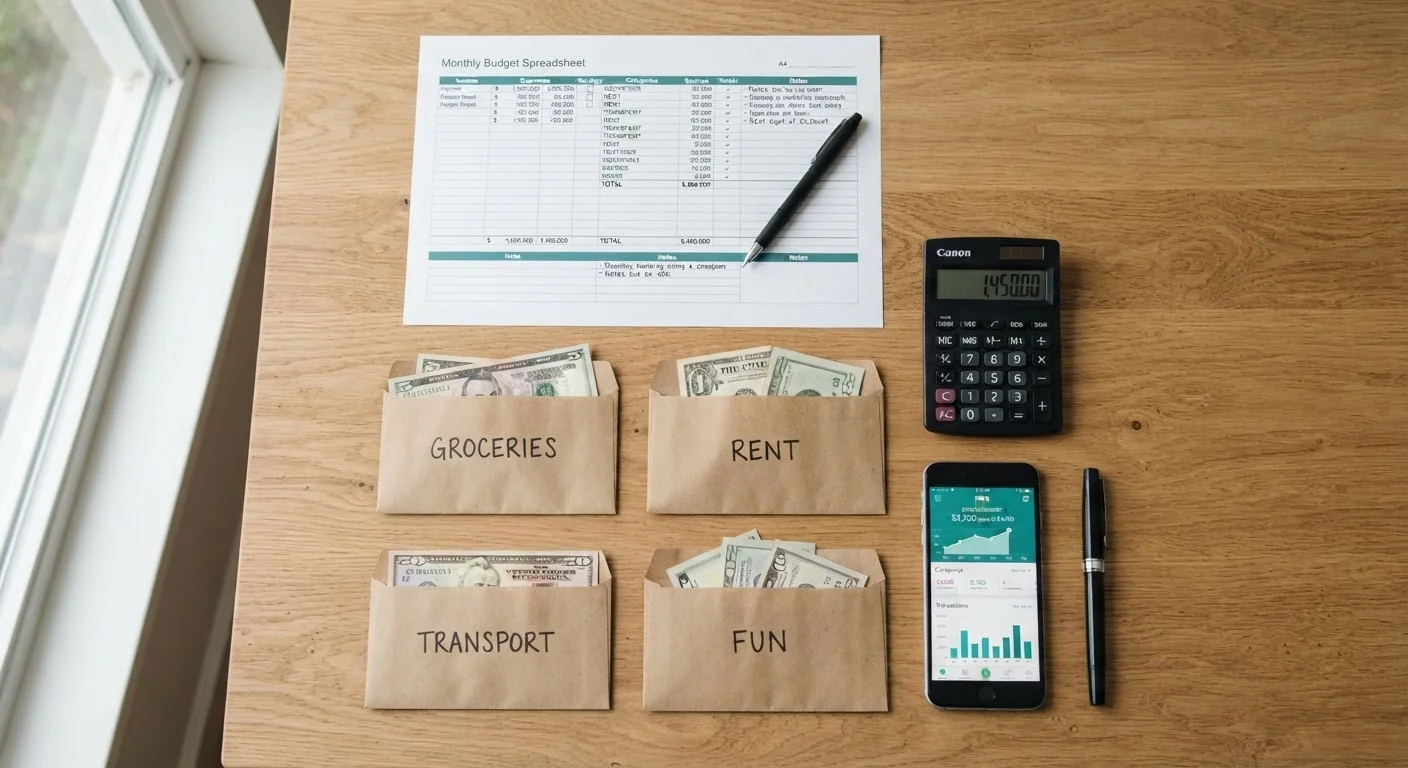
Cash envelope budgeting involves withdrawing physical cash and dividing it into labeled envelopes - one per spending category, such as groceries, gas, or dining out. When an envelope is empty, that category is done for the month.
The psychological power here is real: handing over physical bills creates friction that swiping a card does not. Studies in behavioural economics suggest people tend to spend less when using cash compared to digital payments. The method works especially well for discretionary categories where overspending is common.
The drawbacks are practical. Cash is inconvenient for online purchases, doesn't work easily with automatic bill payments, and carries a risk of loss or theft. It also requires a trip to the bank each pay period, which adds friction of a different kind.
Hybrid Approaches Often Work Best
You don't have to choose just one method in its pure form. Many people use cash envelopes only for their two or three most problematic spending categories - such as groceries and dining - while managing the rest digitally. Experimenting with a hybrid approach can reduce friction while preserving the psychological benefits of whichever method resonates most.
Digital Spreadsheet Budgeting
A spreadsheet budget - built in tools like Google Sheets or Microsoft Excel - puts you in full control of your categories, formulas, and visual layout. You can track income, fixed expenses, variable spending, savings goals, and debt repayment all in one place.
The flexibility is unmatched. You can tailor every row to your actual life, run month-over-month comparisons, and spot trends over time. For those who enjoy numbers and analysis, a well-designed spreadsheet can become a genuinely powerful financial dashboard.
The trade-off is time and discipline. Every transaction must be entered manually (unless you build in data imports), and the system only works if you update it consistently. If you want a frank look at how manual tracking compares to app-based tracking, this comparison of hand tracking vs. apps covers the key trade-offs honestly.
Pay-Yourself-First Method
The pay-yourself-first approach flips the conventional budgeting sequence. Instead of spending and saving whatever remains, you automate a transfer to savings or investment accounts the moment your paycheck arrives - before any discretionary spending occurs.
This method removes the willpower equation. Because savings move automatically, the temptation to spend that money is largely eliminated. It's particularly effective for people who find themselves consistently at zero by the end of the month without meaningful savings to show for it.
The limitation is that it doesn't provide granular control over where the rest of your money goes. For households carrying high-interest debt, the right balance between saving and debt repayment deserves careful thought - a licensed financial adviser can help. See also how an emergency fund and monthly budget work together to understand how saving and spending structures complement each other.
Zero-Based Budgeting
Zero-based budgeting (ZBB) requires that every dollar of income be assigned a specific purpose - expenses, savings, debt payments, or discretionary spending - until your budget reaches exactly zero. The goal is total intentionality: no dollar goes unaccounted for.
ZBB demands more time upfront, especially in the first few months while you calibrate categories to your actual spending patterns. But the payoff is complete visibility. Many people discover they're consistently over-budget in categories they weren't consciously tracking, which creates an immediate opportunity to adjust.
If your income varies from month to month, ZBB requires extra planning because you're building the budget from a different baseline each pay period. Budgeting on an irregular income explores how to adapt structured methods when your paycheck isn't predictable.
~74%
Americans living paycheck to paycheck
Various consumer surveys conducted in recent years suggest a substantial majority of U.S. adults report spending most or all of their monthly income, underscoring the need for structured budgeting.
Less
Spending when using cash vs. cards
Multiple behavioural economics studies have found that consumers tend to spend less when paying with physical cash compared to credit or debit cards, supporting the rationale behind envelope budgeting.
Choosing - and Sticking With - Your Method
The practical test for any budgeting method is consistency over perfection. A simple method you follow every month beats a sophisticated one you abandon after three weeks. Consider your relationship with money, how much time you're willing to invest, and whether you tend to overspend on specific categories or struggle with saving overall.
Couples face an added layer: aligning two different money styles within one system. Budgeting as a couple offers practical frameworks for navigating joint finances without conflict. And if you're carrying debt alongside a budget, comparing debt payoff strategies can help you decide how to allocate dollars beyond basic expenses.
Whatever method you choose, the foundational goal is the same: spend less than you earn, save with intention, and build toward financial stability over time. This article provides general financial information for educational purposes and is not a substitute for personalised advice from a qualified financial professional.
This article is for informational purposes only and does not constitute personalised financial advice. Consult a licensed financial adviser for guidance specific to your situation.