

Key Takeaways
- Ultra-processed foods (UPFs) are defined by their industrial ingredients and processing methods, not just calorie content.
- Observational research links high UPF consumption to several health risks, but causation is not fully established.
- UPFs offer real advantages in cost, convenience, and shelf life that matter in everyday life.
- A diet context matters more than any single food category - balance and overall pattern are key.
- Consulting a registered dietitian can help you navigate food choices for your specific health situation.
Affordable and accessible across income levels
UPFs are typically cheaper per calorie than fresh whole foods, making them important sources of energy for budget-constrained households. In many areas, they are also available in stores where fresh produce is limited.
Long shelf life reduces food waste
Preservatives and packaging extend the usable life of UPFs well beyond that of perishable foods, reducing spoilage - a meaningful benefit for households that cannot shop frequently.
Convenient for time-limited households
Many UPFs require minimal preparation, making them practical for people working long hours, managing caregiving responsibilities, or lacking adequate cooking facilities.
Some UPFs are fortified with key nutrients
Products like fortified breakfast cereals and enriched breads can be meaningful sources of B vitamins, iron, and folic acid - nutrients that some populations struggle to obtain in sufficient amounts.
Consistent flavor supports regular eating patterns
For individuals with sensory sensitivities or appetite challenges - including older adults and some children - the reliable palatability of UPFs can support adequate caloric intake.
Often high in added sugars and sodium
Many UPFs contain substantial amounts of added sugar and sodium, both of which, in excess, are associated with cardiovascular risk and other health concerns according to public health guidance.
Typically low in dietary fiber
The refining processes used in many UPFs strip out naturally occurring fiber. Most Americans already fall well short of recommended fiber intake, and high UPF consumption may widen that gap.
May promote overconsumption through palatability
UPFs are often engineered for maximal appeal - combining salt, fat, and sugar in ways that can make portion regulation more difficult, according to emerging appetite research.
Can displace nutrient-dense whole foods
When UPFs make up a large share of total calories, there is less room for vegetables, legumes, and whole grains that contribute fiber, phytonutrients, and micronutrients associated with long-term health.
Contain additives with uncertain long-term effects
Some emulsifiers, artificial colorings, and flavor enhancers common in UPFs are under active research for potential effects on gut health and inflammation - though evidence in humans remains preliminary.
Our Verdict
Ultra-processed foods present a genuine nutritional trade-off: they are accessible, affordable, and convenient, but many are also high in added sugars, sodium, and refined ingredients while low in dietary fiber and micronutrients. The research associating frequent UPF consumption with health risks is growing but still largely observational. Reducing reliance on UPFs where practical - rather than eliminating them entirely - is a realistic goal supported by current dietary guidance.
This article is most useful for readers who want to understand the science behind ultra-processed foods without adopting rigid dietary rules or feeling unnecessarily alarmed.
What 'Ultra-Processed' Actually Means
The term ultra-processed food (UPF) comes from the NOVA classification system, developed by researchers at the University of São Paulo. NOVA groups foods into four categories based on the extent and purpose of processing - not simply whether they have been cooked or packaged. Ultra-processed foods sit in the fourth and most-processed tier.
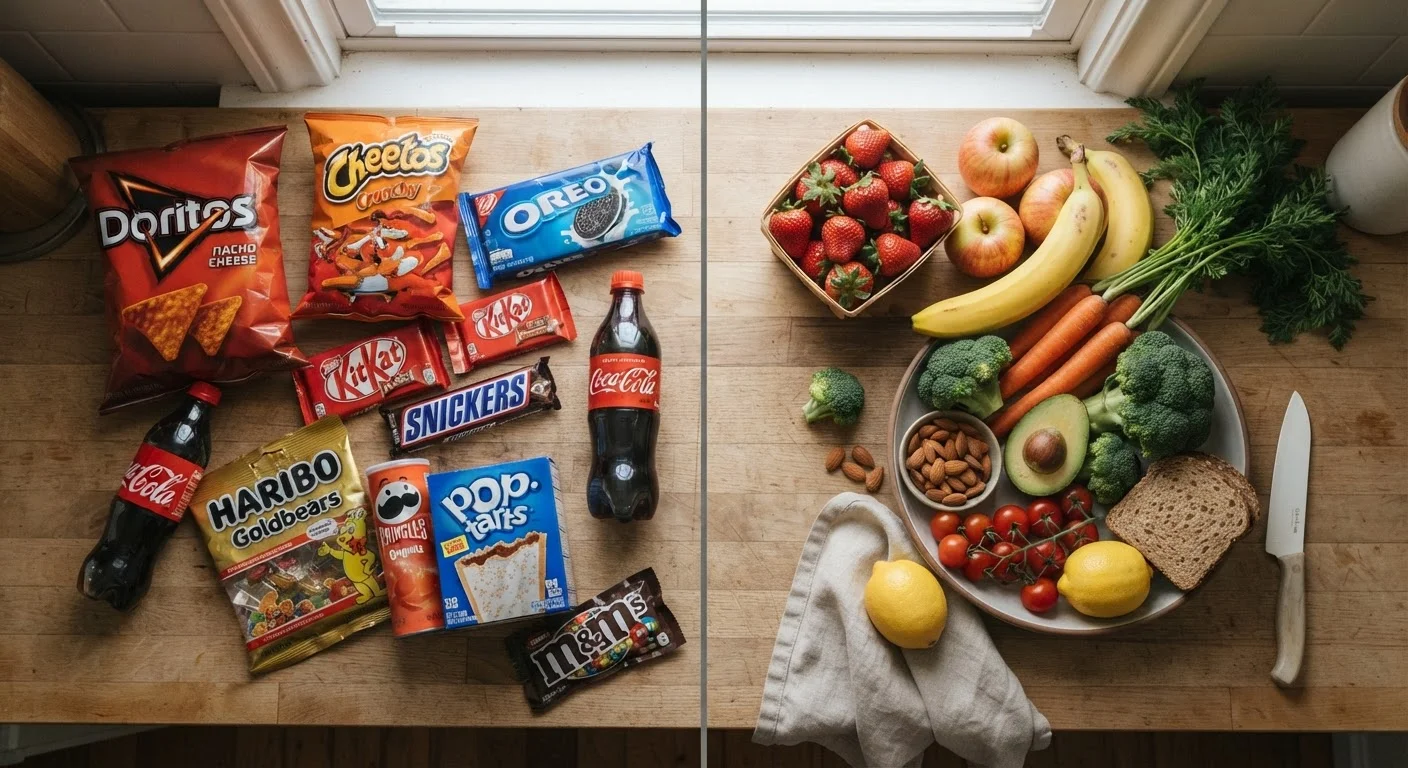
UPFs are defined by the presence of industrial ingredients rarely used in home cooking - such as hydrogenated oils, modified starches, artificial flavors, emulsifiers, and color additives - combined with formulation techniques designed primarily to maximize palatability, shelf life, and convenience. Examples include carbonated soft drinks, packaged sweet snacks, instant noodles, reconstituted meat products, and many breakfast cereals.
Importantly, the NOVA classification is about process and ingredient composition, not calories or macronutrients alone. Some UPFs are low in fat; some whole foods are high in saturated fat. This distinction matters when interpreting research, since UPF status and nutritional quality are related but not identical concepts.
NOVA Is a Research Tool, Not a Food Law
The NOVA classification system is widely used in nutrition epidemiology but is not an official regulatory standard. It was not designed as a consumer label or a definitive guide for individual food choices. Different researchers sometimes classify the same products differently, which can affect study comparisons. Understanding this limitation helps you interpret UPF research more critically.
What the Evidence Suggests About Health Risks
A growing body of research links diets high in ultra-processed foods to adverse health outcomes. Large observational studies - including cohort studies from the UK Biobank, the French NutriNet-Santé project, and U.S. dietary surveys - have found associations between high UPF intake and elevated risks of cardiovascular disease, type 2 diabetes, certain cancers, depression, and all-cause mortality.
~58%
Share of U.S. daily calories from UPFs
Research published in the BMJ using NHANES data estimated that ultra-processed foods account for roughly 57-58% of total caloric intake among U.S. adults.
~10%
Increased all-cause mortality risk association
A large observational cohort study published in JAMA Internal Medicine found a roughly 10% higher risk of all-cause mortality associated with a 10-percentage-point increase in the share of UPFs in the diet.
However, it is important to be precise about what this evidence does and does not show. Most studies in this area are observational, meaning they can identify associations but cannot confirm that UPFs cause these outcomes. People who consume more UPFs may also have less access to fresh food, more sedentary lifestyles, higher stress levels, or other confounding factors that independently affect health. Randomized controlled trials - the gold standard for establishing causation - are limited in this area, partly because long-term dietary interventions are methodologically difficult to conduct.
Proposed biological mechanisms include disruption of gut microbiota, increased exposure to food additives, displacement of fiber-rich whole foods, and promotion of overconsumption through highly palatable formulations. These mechanisms are plausible and under active study, but the science is not yet settled.
For further context on specific ingredients associated with UPFs, see our article on hidden sodium in everyday foods and our overview of added sugar vs. natural sugar.
The Real Advantages Ultra-Processed Foods Provide
A fair assessment of UPFs has to acknowledge why they are so prevalent in American diets. For many households, they are not a failure of willpower - they are a practical solution to real constraints.
Affordable and accessible across income levels
UPFs are typically cheaper per calorie than fresh whole foods, making them important sources of energy for budget-constrained households. In many areas, they are also available in stores where fresh produce is limited.
Long shelf life reduces food waste
Preservatives and packaging extend the usable life of UPFs well beyond that of perishable foods, reducing spoilage - a meaningful benefit for households that cannot shop frequently.
Convenient for time-limited households
Many UPFs require minimal preparation, making them practical for people working long hours, managing caregiving responsibilities, or lacking adequate cooking facilities.
Some UPFs are fortified with key nutrients
Products like fortified breakfast cereals and enriched breads can be meaningful sources of B vitamins, iron, and folic acid - nutrients that some populations struggle to obtain in sufficient amounts.
Consistent flavor supports regular eating patterns
For individuals with sensory sensitivities or appetite challenges - including older adults and some children - the reliable palatability of UPFs can support adequate caloric intake.
Dismissing the role of convenience, cost, and accessibility in food choices does not serve readers well. Any sustainable approach to healthier eating has to account for the realities of time, budget, and food access. Our guide to building a balanced meal without a formula offers practical strategies that work within those constraints.
The Nutritional Downsides Worth Understanding
While UPFs are not uniformly harmful, they do share some common nutritional characteristics that, in aggregate, may work against long-term health - particularly when they displace minimally processed whole foods in the diet.
Often high in added sugars and sodium
Many UPFs contain substantial amounts of added sugar and sodium, both of which, in excess, are associated with cardiovascular risk and other health concerns according to public health guidance.
Typically low in dietary fiber
The refining processes used in many UPFs strip out naturally occurring fiber. Most Americans already fall well short of recommended fiber intake, and high UPF consumption may widen that gap.
May promote overconsumption through palatability
UPFs are often engineered for maximal appeal - combining salt, fat, and sugar in ways that can make portion regulation more difficult, according to emerging appetite research.
Can displace nutrient-dense whole foods
When UPFs make up a large share of total calories, there is less room for vegetables, legumes, and whole grains that contribute fiber, phytonutrients, and micronutrients associated with long-term health.
Contain additives with uncertain long-term effects
Some emulsifiers, artificial colorings, and flavor enhancers common in UPFs are under active research for potential effects on gut health and inflammation - though evidence in humans remains preliminary.
The concern is less about any single product and more about dietary pattern. Research on whole grains versus refined grains illustrates how food processing can diminish the nutritional value of otherwise beneficial ingredients. For readers exploring broader dietary patterns, our article on plant-based vs. omnivore eating examines how food group composition - not just individual foods - shapes nutritional outcomes.
A Practical Approach: Context Over Categorization
Current dietary guidance from bodies like the Dietary Guidelines for Americans emphasizes overall eating patterns rather than the elimination of entire food categories. No single food - ultra-processed or otherwise - determines health outcomes in isolation.
A useful starting point is to evaluate UPFs by their nutritional label rather than their NOVA category alone. A fortified whole-grain cereal classified as ultra-processed may offer more fiber and micronutrients than an artisanal snack bar. Conversely, some minimally processed foods are high in saturated fat or sodium. Reading labels with an eye toward fiber, sodium, and added sugar content gives you more actionable information than classification alone. Our weekly grocery checklist for better nutrition can help you stock a kitchen that naturally reduces UPF reliance without requiring an overhaul.
If you have specific health conditions, dietary restrictions, or concerns about your eating patterns, a registered dietitian is the most appropriate resource for personalized guidance.
This article is for general informational and educational purposes only and is not a substitute for professional medical or dietary advice. Consult a qualified healthcare provider or registered dietitian before making significant changes to your diet, especially if you have existing health conditions.