
Insulation Types for American Homes: Batts, Blown-In, Spray Foam, and Rigid Board

Key Takeaways
- R-value measures thermal resistance - higher numbers mean better insulating performance per inch.
- Batt insulation is DIY-friendly and cost-effective for open wall cavities and attic floors.
- Blown-in insulation excels in irregularly shaped spaces and finished areas with limited access.
- Spray foam provides an air seal and insulation in one step, but typically requires professional installation.
- Rigid board insulation works best on exterior walls, basement walls, and under slabs where moisture resistance matters.
Our Verdict
No single insulation type suits every application. Batts are practical for straightforward framing, blown-in handles hard-to-reach voids, spray foam delivers superior air sealing in critical areas, and rigid board protects moisture-prone surfaces. The right choice depends on location, climate, budget, and whether permits or professional installation are required in your area.
| Best for | Recommended |
|---|---|
| Homeowners doing accessible attic or wall cavity work themselves | Fiberglass or mineral wool batts |
| Retrofitting insulation into existing finished walls or attics | Blown-in (loose-fill) insulation |
| Maximizing air sealing in crawl spaces, rim joists, or new construction | Spray foam insulation |
| Insulating basement walls, exterior continuous layers, or under slabs | Rigid board insulation |
Why Insulation Type Matters Beyond R-Value
When evaluating insulation, most homeowners start - and stop - at R-value. R-value measures thermal resistance, and it matters a great deal, but it's only part of the picture. How insulation is installed, whether it controls moisture and air movement, and how well it conforms to irregular surfaces all determine real-world performance.
Each of the four main insulation types - batt, blown-in, spray foam, and rigid board - has distinct characteristics. Understanding these differences helps homeowners make smarter decisions, avoid costly mistakes, and know when to call a professional versus when a project is safely DIY-friendly.
| Batt | Blown-In | Spray Foam | Rigid Board | |
|---|---|---|---|---|
| Typical R-value per inch | R-3.1 to R-4.3 | R-2.2 to R-3.8 | R-3.7 to R-6.5 | R-3.8 to R-6.5 |
| Best application | Open wall cavities, attic floors | Attics, existing finished walls | Rim joists, crawl spaces, rooflines | Exterior walls, basements, under slabs |
| Air sealing ability | None on its own | Minimal | Excellent (both types) | Moderate (seams must be sealed) |
| Moisture resistance | Low (fiberglass), moderate (mineral wool) | Low to moderate | High (closed-cell), low (open-cell) | High (XPS, EPS), moderate (polyiso) |
| DIY suitability | High | Moderate | Low - typically professional | Moderate |
| Relative installed cost | Lower | Moderate | Higher | Moderate |
Batt Insulation: Accessible and Budget-Conscious
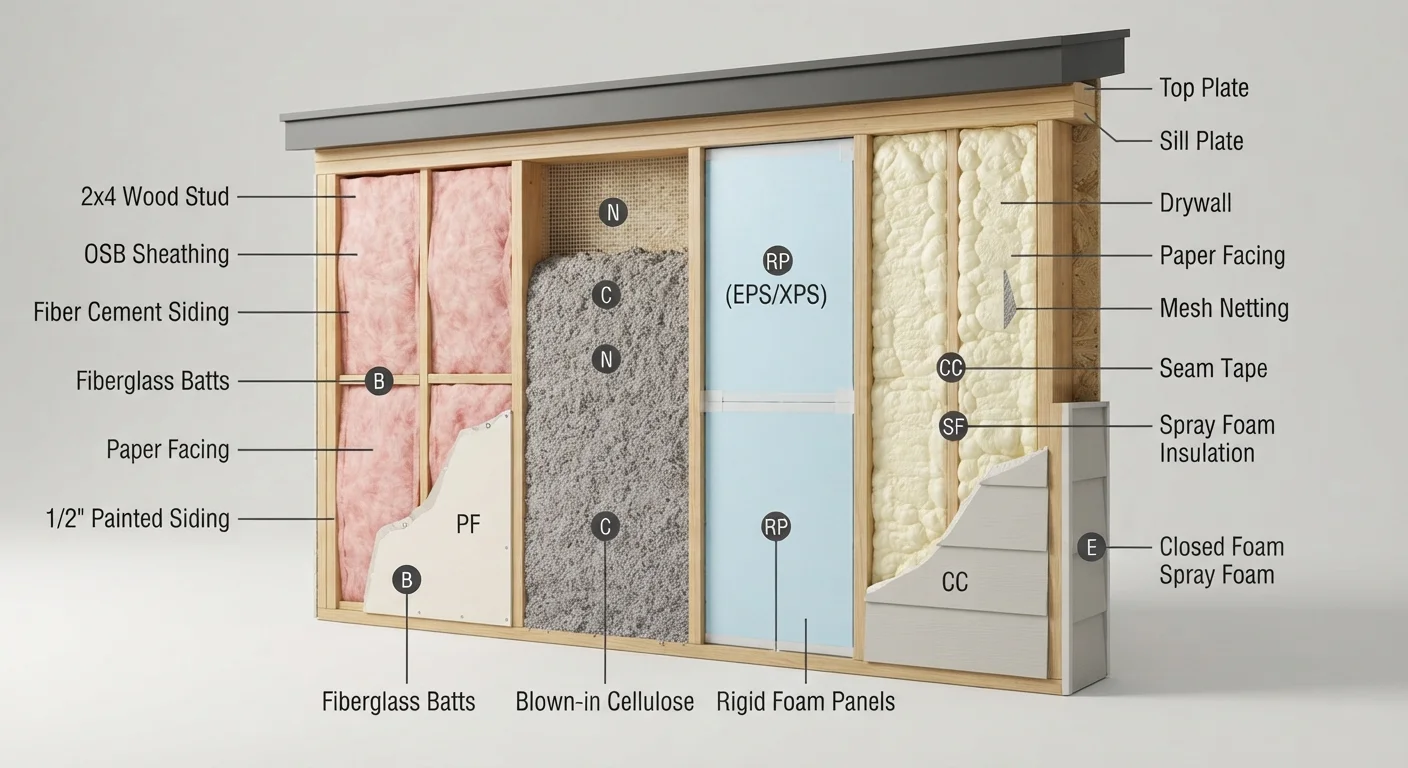
Batt insulation comes in pre-cut panels or rolls, most commonly made from fiberglass or mineral wool (also called rock wool). It's designed to fit snugly between standard wall studs, floor joists, and attic rafters spaced at 16 or 24 inches on center.
Where it works well: Open wall cavities during construction or renovation, attic floors, and floor assemblies over unconditioned spaces like garages.
Limitations to know: Batts must be carefully fitted around obstacles like wiring and plumbing. Gaps, compression, or improper facing orientation significantly reduce effective R-value. Mineral wool batts are more fire-resistant and moisture-tolerant than fiberglass, though typically at a higher cost.
Cut Batts Precisely for Best Results
When fitting batt insulation around pipes, wires, or other obstructions, split the batt horizontally and wrap each half around the obstacle rather than compressing the full batt. Compression reduces effective R-value significantly. Always wear gloves, long sleeves, and an N95 mask when handling fiberglass batts.
Batt insulation does not act as an air barrier on its own. Pairing it with proper air sealing - for example, using caulk or foam around penetrations - is essential for full performance. See our guide to sealing your home against drafts for complementary steps.
Blown-In Insulation: The Retrofit Workhorse
Blown-in (loose-fill) insulation is made from cellulose (recycled paper fiber) or fiberglass. It's installed using a blowing machine that distributes material into cavities, making it ideal for irregular shapes, hard-to-reach attic floors, and existing finished walls accessed through small drill holes.
Where it works well: Attics with many obstructions, walls in existing homes where opening drywall isn't practical, and anywhere coverage needs to conform to complex framing.
Limitations to know: Cellulose can settle over time, reducing R-value - professional installers typically account for settling by overfilling. Blown-in also requires a blower machine, which is often available for rental at home improvement stores, though achieving consistent density in wall cavities typically requires professional equipment and expertise. Always verify local code requirements before beginning any insulation work.
~11%
Heat loss through an uninsulated attic
According to the U.S. Department of Energy, heating and cooling account for roughly half of home energy use, with poorly insulated attics being a major contributor.
15%-30%
Estimated energy savings from air sealing and insulation
The U.S. EPA's ENERGY STAR program estimates that properly sealing and insulating can reduce heating and cooling costs by 15% or more, though results vary by home and climate.
Spray Foam Insulation: Air Sealing and Insulation Combined
Spray polyurethane foam (SPF) expands on contact to fill cavities, gaps, and irregular surfaces. It comes in two forms: open-cell foam (lower density, lower R-value per inch, vapor-permeable) and closed-cell foam (denser, higher R-value per inch, moisture-resistant, and structurally reinforcing).
Where it works well: Rim joists, crawl space walls, rooflines in conditioned attics, and areas where both air sealing and insulation are critical. Closed-cell foam is particularly effective in flood-prone or high-humidity zones.
Limitations to know: Spray foam is typically the most expensive insulation option per square foot. Full-coverage application requires professional installation - improper mixing ratios or application technique can result in off-ratio foam that performs poorly and may emit harmful compounds. Some jurisdictions require permits for spray foam in certain applications; always check local building codes before proceeding.
Note: Spray foam installation involves chemical compounds that require proper protective equipment. This is a project best left to licensed insulation contractors in most residential applications.
Rigid Board Insulation: Moisture-Resistant and Continuous
Rigid insulation boards - typically made from expanded polystyrene (EPS), extruded polystyrene (XPS), or polyisocyanurate (polyiso) - provide a continuous layer of insulation that eliminates thermal bridging through studs and framing. They're solid panels cut to size with standard tools.
Where it works well: Exterior wall sheathing, basement and crawl space walls, under concrete slabs, and in low-profile assemblies where space is limited. XPS and EPS both offer solid moisture resistance, making them suited for below-grade applications.
Limitations to know: Rigid board alone doesn't seal air gaps - seams must be taped or foamed. Polyiso performs less effectively in very cold temperatures. Some rigid foam products require a thermal or ignition barrier (such as drywall) over them when installed in living spaces; check local codes and manufacturer requirements.
Properly insulating your home also connects to broader considerations around protecting your investment. Whether you own or rent, understanding your coverage options is worth reviewing - see our overview of homeowners insurance vs. renters insurance for context on how your policy applies to your property.