

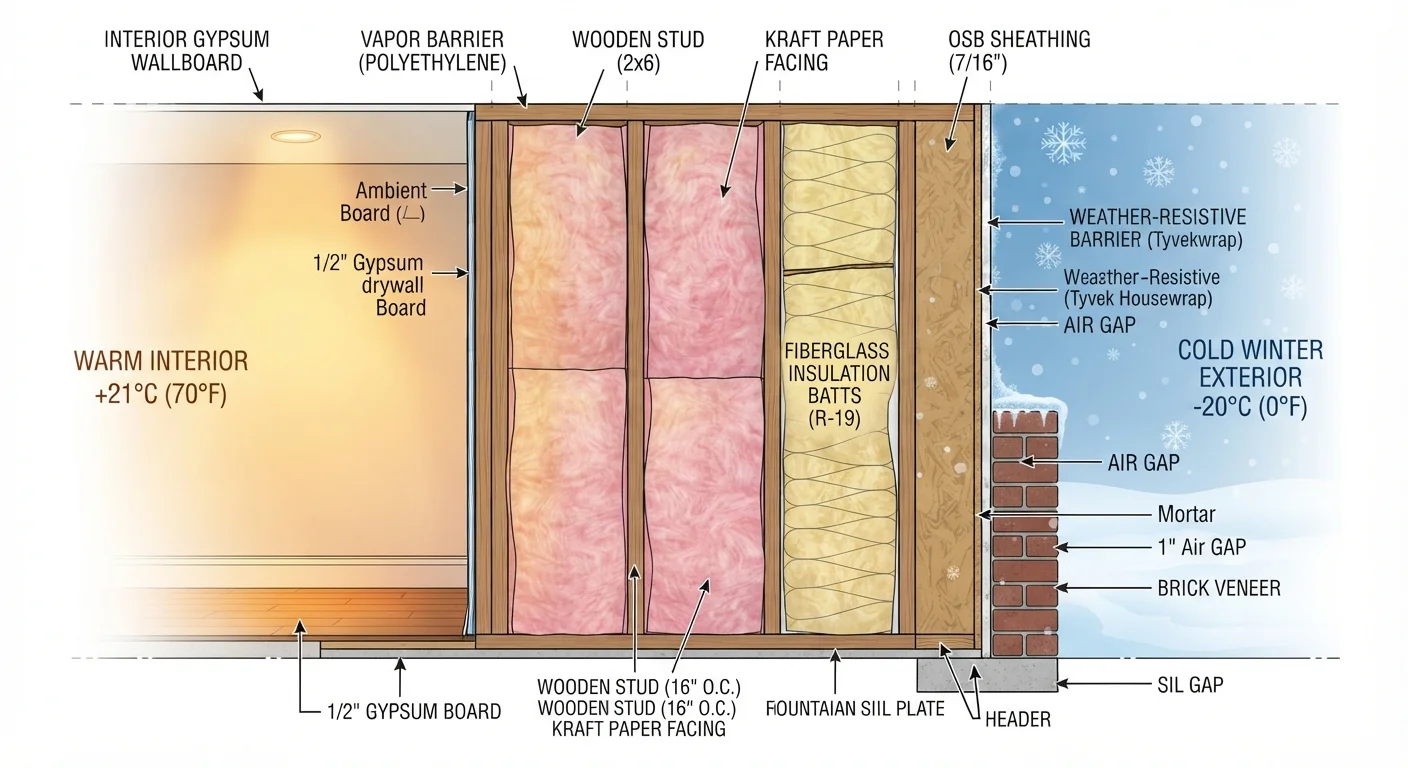
Key Takeaways
- R-value measures thermal resistance - higher numbers mean better insulation performance.
- Different parts of a home (attic, walls, floors) require different minimum R-values based on climate zone.
- R-value is additive, so layering insulation materials increases total resistance.
- Moisture, compression, and improper installation can reduce insulation's effective R-value.
- The U.S. Department of Energy publishes recommended R-values by climate zone as a reliable reference.
R-Value
R-value is a number that measures how well an insulating material resists the flow of heat. The higher the R-value, the more resistant the material is, meaning heat moves through it more slowly. In practical terms, a higher R-value means your home stays warmer in winter and cooler in summer with less energy spent by your heating and cooling systems.
R-value is calculated as the ratio of temperature difference across a material to the heat flux through it, expressed in units of °F·ft²·h/BTU in the U.S. system. It is additive - layers of insulation can be combined, and their individual R-values are simply summed.
Why a Single Number Matters So Much
If you've ever shopped for insulation or read a home energy audit report, you've seen the term R-value. It looks like a simple label - R-13, R-19, R-49 - but it carries real consequences for comfort and energy use. Every material through which heat travels has a measurable rate of resistance, and R-value is the standardized way to compare them.
Think of R-value as a friction score for heat. Low-resistance materials (single-pane glass, thin drywall) let heat move freely. High-resistance materials (fiberglass batts, rigid foam boards, spray foam) slow it down considerably. When your home's building envelope - the walls, ceiling, floor, and foundation - has adequately high R-values, your heating and cooling equipment doesn't have to work as hard to maintain a comfortable indoor temperature.
Up to 30%
Heating and cooling energy lost through air leaks and poor insulation
According to the U.S. Department of Energy, roughly a quarter to a third of home heating and cooling energy is lost due to inadequate insulation and air infiltration.
8
U.S. climate zones with differing insulation requirements
The DOE's climate zone map divides the country into eight zones, each with distinct R-value recommendations for attics, walls, and floors.
R-49 to R-60
Recommended attic R-value for cold northern U.S. climates
The DOE recommends these attic insulation levels for homeowners in climate zones 6-8, covering much of the northern United States.
How R-Value Is Determined and Why Installation Matters
Manufacturers test insulation products in controlled laboratory conditions and assign an R-value per inch of thickness. That number assumes the material is dry, uncompressed, and installed correctly. In real-world conditions, performance can fall short of the label if those assumptions don't hold.
- Compression: Squeezing a batt insulation into a space thinner than its design thickness reduces its effective R-value. A 3.5-inch R-13 batt stuffed into a 2.5-inch cavity won't perform at R-13.
- Moisture: Water conducts heat. Insulation that has absorbed moisture - from a slow roof leak or condensation - loses thermal resistance. Wet insulation can also harbor mold.
- Gaps and voids: Leaving even small uncovered areas dramatically reduces the overall performance of a wall or ceiling assembly, because heat concentrates through the path of least resistance.
Because installation quality is so critical, hazardous tasks like blown-in insulation for attics or spray foam application in enclosed cavities are best left to licensed professionals. Always verify whether insulation work requires a building permit in your municipality before starting.
Check Before You Install
Before purchasing or installing insulation, use the U.S. Department of Energy's online ZIP code tool to look up the recommended R-values for your specific climate zone and building assembly. This takes just a few minutes and helps you avoid over- or under-insulating, both of which represent wasted money.
Climate Zones and Recommended R-Values
The United States is divided into eight climate zones by the Department of Energy, ranging from the hot and humid Gulf Coast (Zone 1) to the frigid northern states and Alaska (Zone 7-8). Recommended minimum R-values differ significantly across these zones.
As a general orientation:
- Attics typically require the highest R-values - often R-38 to R-60 - because heat rises and the roof assembly is the most vulnerable part of the envelope.
- Walls in new construction commonly target R-13 to R-21, depending on framing depth and climate.
- Floors over unconditioned spaces (crawl spaces, garages) usually call for R-19 to R-30.
Homeowners renting their space have less control over structural insulation, but there are still small steps to improve comfort - draft stoppers, thermal curtains, and outlet insulator pads are all renter-friendly options. For more on what you can reasonably modify in a rental, see our guide to renter-friendly home changes.
R-Value Recommendations Are Minimums
The DOE's zone-based R-value recommendations represent minimum thresholds - not ceilings. Exceeding them is rarely wasteful in climates with extreme seasonal temperature swings, where additional resistance continues to reduce the load on heating and cooling equipment. Budget, available space, and the law of diminishing returns are the practical limits.
Reading R-Value in the Context of Your Home's Overall Performance
R-value is one piece of a larger energy-efficiency puzzle. Air sealing, window quality (measured in U-factor), thermal bridging through wood framing, and mechanical system efficiency all interact. A well-insulated home that still has significant air leaks around plumbing penetrations or recessed lights will still lose conditioned air - and energy dollars - continuously.
A professional home energy audit can identify where your building envelope is underperforming and prioritize improvements by impact. Many utility companies offer subsidized audits or rebate programs for insulation upgrades; contacting your local utility is a good first step before investing in materials or labor.
Understanding R-value empowers you to ask better questions of contractors, evaluate insulation bids more critically, and make sense of energy audit recommendations - all without needing a background in building science.