
Textiles That Transform a Room: Curtains, Throws, Cushions, and What Each One Does

Key Takeaways
- Curtains influence light, perceived ceiling height, and a room's acoustic warmth simultaneously.
- Throws add both tactile comfort and a quick way to introduce new color or texture seasonally.
- Cushions work as a low-commitment tool for testing pattern and color before committing to larger changes.
- Textile weight and fiber content affect how a fabric performs - not just how it looks.
- Layering different textile types creates depth that single-item decorating cannot achieve.
Why Textiles Are a Room's Most Underrated Tool
Paint and furniture get most of the credit when a room looks pulled together, but soft furnishings are often doing the heavier lifting. Curtains, throws, and cushions collectively affect how a space feels acoustically, how warm or cool it reads visually, and how inviting it is on a practical, physical level. Because textiles are relatively easy to swap out, they're also one of the most accessible levers available to anyone redecorating on a budget.
If you're starting from scratch or refreshing a tired room, it helps to understand what each textile type actually contributes - rather than reaching for them purely on instinct. The list below breaks down each one's functional and aesthetic role so you can make deliberate choices rather than decorative guesses.
Before layering textiles into a room, it's worth considering what you're working with. Clearing the space first gives you a cleaner read on what each room actually needs.
Curtains: Light, Height, and Sound Control
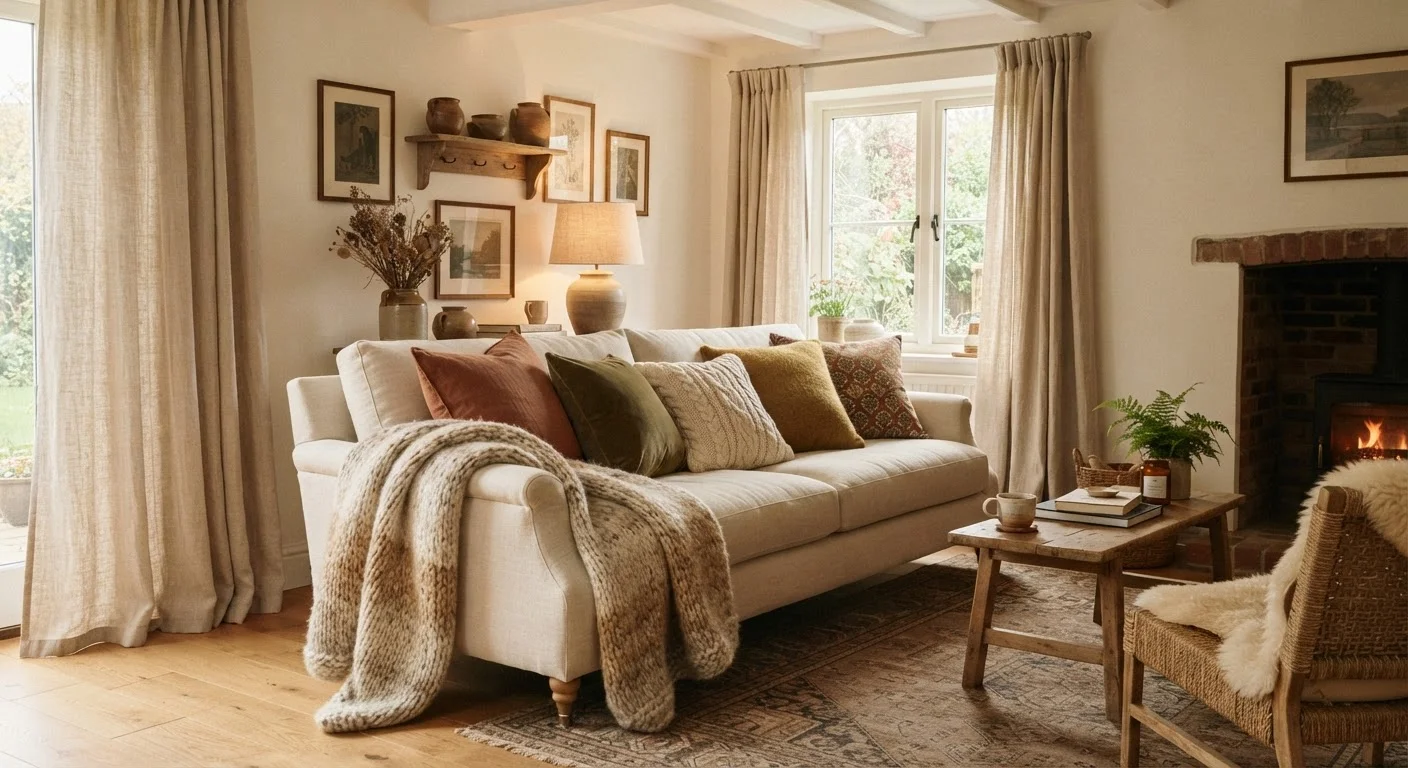
Curtains do three things at once that most people only credit them with one: they manage natural light, they manipulate the perceived proportions of a room, and they absorb sound. Hanging curtains closer to the ceiling than to the window frame - even by several inches - draws the eye upward and makes ceilings read as taller. Wide panels that extend beyond the window edges make windows appear larger than they are.
Fabric weight matters here. Heavyweight options like velvet or lined cotton suppress outside noise noticeably and block light effectively. Sheer linen or cotton voile filters light softly while maintaining privacy during daylight hours. Unlined curtains in lighter fabrics tend to billow gracefully but offer minimal insulation. For rooms where temperature regulation is a concern, thermal-lined curtains can help reduce heat loss near windows during colder months.
Hanging curtains close to the ceiling - not the window - makes any room feel taller.
Throws: Seasonal Flexibility and Tactile Warmth
A throw is among the most versatile soft furnishings in a room because it serves a purely functional purpose - warmth - while also acting as a styling layer that can be rotated seasonally without significant cost. A chunky knit throw in winter signals coziness; the same spot with a lightweight cotton or linen throw in summer reads as relaxed and breezy rather than heavy.
Where you place a throw also matters. Draped casually over one arm of a sofa introduces asymmetry, which tends to make a room feel lived-in rather than staged. Folded neatly over a footstool or bed end gives a more tailored look. A throw in a contrasting texture to the sofa fabric - say, a woven cotton throw on a smooth leather couch - immediately adds the kind of visual interest that a second cushion alone wouldn't achieve.
Swapping throws seasonally is one of the easiest ways to refresh a room without redecorating.
Cushions: Pattern, Color, and Low-Risk Experimentation
Cushions are the lowest-commitment textile in a room, which makes them uniquely useful for testing ideas you're not ready to commit to at a larger scale. If you're curious whether a burnt orange accent would work in your living room, a pair of cushions is a far more forgiving way to find out than a feature wall.
The most effective cushion arrangements mix scale - at least one larger cushion alongside smaller ones - and introduce some variation in texture or pattern, even within a tightly controlled color palette. Identical cushions in a perfectly symmetrical arrangement tend to read as showroom rather than home. Odd numbers, mismatched sizes, and at least one textured fabric (boucle, velvet, or linen) typically produce a more grounded, layered result. Some widely held matching rules are worth questioning - cushions are a good place to start experimenting.
Cushions are the lowest-risk way to test a new color or pattern before committing at scale.
Rugs: Anchoring and Acoustic Dampening
Though often considered flooring rather than soft furnishing, rugs function more like textiles than hard surfaces - they absorb sound, define zones within open-plan spaces, and add underfoot warmth that no amount of cushions or curtains can replicate. In rooms with hard flooring, a rug can soften the acoustic quality of the space noticeably, reducing echo and making conversation feel less effortful.
Size is the variable most commonly misjudged. A rug that is too small - particularly in a living room where it only fits under the coffee table - floats visually rather than anchoring the seating arrangement. As a general principle, all key furniture legs in a seating group should either sit fully on the rug or fully off it; partial contact with front legs only tends to look unintentional rather than considered.
A correctly sized rug anchors furniture and absorbs sound in ways that other soft furnishings cannot.
Table Linens and Fabric Lampshades: The Supporting Cast
Textiles in a room extend beyond the obvious - tablecloths, placemats, fabric lampshades, and upholstered headboards all contribute to the overall textile weight of a space. These smaller-scale elements matter particularly in rooms where the main furniture is already fixed, because they provide an opportunity to add color, pattern, or texture without touching the sofa or the walls.
Fabric lampshades, for example, affect both the quality and warmth of artificial light in the evening. A linen or cotton shade diffuses light softly and creates a warmer atmosphere than a hard plastic or paper equivalent. Table runners used on a dining table break up a large expanse of wood without the full commitment of a tablecloth. When chosen in a fabric or color that echoes something already present in the room - a cushion, a throw - these smaller pieces help a room feel considered rather than assembled from unrelated parts.
Fabric lampshades and table linens add textile depth without touching the room's major furnishings.
Putting It All Together
The most successful textile schemes in a room are layered - they combine at least two or three textile types that differ in weight, texture, or scale. A heavy curtain pairs well with a lightweight linen cushion; a chunky wool throw balances a smooth velvet sofa. Contrast in texture keeps a room from feeling flat, even when the color palette is deliberately restrained.
Start With One Anchor Textile
When building a textile scheme from scratch, choose one piece - often a rug or a curtain - as your anchor and select everything else in relation to it. This prevents the common mistake of buying individual items you love in isolation that don't cohere as a group. The anchor piece sets the tone for scale, color temperature, and texture level for everything that follows.
If you're working within a specific design style, textiles are one of the most style-defining elements in any room. Understanding your preferred interior style can help narrow down which fabrics, weights, and patterns will feel cohesive rather than random. And if your room feels crowded regardless of your textile choices, design strategies for small spaces can help you rethink the layout before adding more layers.