

| Saturated fat state at room temp | Solid |
| Unsaturated fat state at room temp | Liquid |
| Primary source of artificial trans fat | Partially hydrogenated oils (PHOs) (U.S. FDA) |
| Omega-3 classification | Polyunsaturated fat (PUFA) |
| FDA action on PHOs | Determined not generally recognized as safe; phased out (U.S. FDA) |
| Saturated fat daily limit (general guidance) | Less than 10% of total daily calories (2020-2025 Dietary Guidelines for Americans) |
Why Fat Types Matter More Than Total Fat
For decades, dietary advice focused on cutting fat across the board. Current nutrition science tells a more nuanced story: the type of fat you eat tends to matter more than the total amount. The three major categories - saturated, unsaturated, and trans - behave differently in the body and appear in very different foods.
This reference covers what each type is, where it commonly shows up, and what mainstream nutrition guidance generally says about it. For a broader look at how dietary fat fits into your overall eating pattern, see our piece on what carbs, protein, and fat actually do in your body.
| Saturated fat state at room temp | Solid |
| Unsaturated fat state at room temp | Liquid |
| Primary source of artificial trans fat | Partially hydrogenated oils (PHOs) (U.S. FDA) |
| Omega-3 classification | Polyunsaturated fat (PUFA) |
| FDA action on PHOs | Determined not generally recognized as safe; phased out (U.S. FDA) |
| Saturated fat daily limit (general guidance) | Less than 10% of total daily calories (2020-2025 Dietary Guidelines for Americans) |
Saturated Fat: What It Is and Where It Comes From
Saturated fat gets its name from its chemical structure: its carbon chain is fully "saturated" with hydrogen atoms, leaving no double bonds. This structure makes it solid at room temperature - think butter, lard, or coconut oil.
Common food sources include:
- Fatty cuts of beef and pork
- Full-fat dairy (cheese, cream, whole milk)
- Butter and ghee
- Coconut oil and palm oil
- Many baked goods and processed snacks made with the above
Major health organizations, including the American Heart Association, generally recommend limiting saturated fat intake, as higher consumption has been associated with elevated LDL ("bad") cholesterol levels in many studies. That said, the relationship between saturated fat and cardiovascular risk is an active area of research, and researchers continue to debate context, food source, and overall dietary pattern. For guidance specific to your health situation, consult a registered dietitian or your healthcare provider.
Saturated Fat Research Is Still Evolving
While many major health organizations advise limiting saturated fat, some researchers argue the relationship depends heavily on what replaces it in the diet - refined carbohydrates, for instance, may not be a net improvement. The food source also appears to matter: dairy-based saturated fat may behave differently than that from processed meats. This is an area of active scientific debate, so sweeping conclusions in either direction should be treated with caution.
Unsaturated Fat: The Broader Category Worth Knowing
Unsaturated fat contains one or more double bonds in its carbon chain, making it liquid at room temperature. This category divides into two sub-types:
- Monounsaturated fat (MUFA)
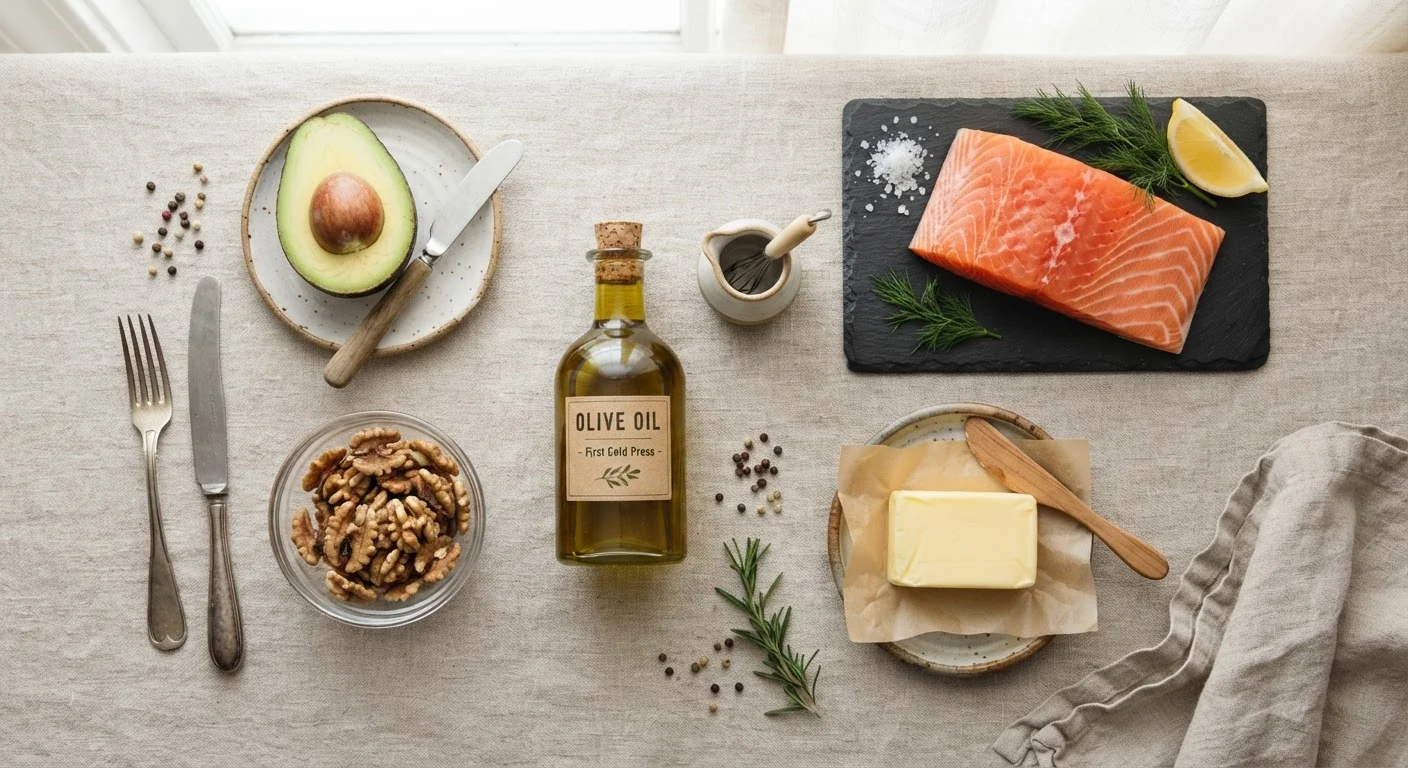
- One double bond. Found in olive oil, avocados, almonds, and peanuts. Frequently highlighted in Mediterranean-style dietary patterns.
- Polyunsaturated fat (PUFA)
- Two or more double bonds. Includes omega-3 and omega-6 fatty acids. Found in fatty fish, walnuts, flaxseed, and many vegetable oils (sunflower, soybean, corn).
Omega-3 fatty acids - found in salmon, mackerel, sardines, chia seeds, and walnuts - have been widely studied for their potential role in heart and brain health. Most dietary guidance suggests that replacing saturated fats with unsaturated fats, rather than simply adding more fat overall, is the more meaningful shift for most people.
When you're checking labels for fat type breakdowns, our guide to reading a Nutrition Facts label can help you locate and interpret those numbers quickly.
Saturated fat
A type of dietary fat whose carbon chain has no double bonds and is fully loaded with hydrogen atoms. It is solid at room temperature and found mainly in animal products and some tropical oils.
Monounsaturated fat (MUFA)
An unsaturated fat with a single double bond in its carbon chain. Olive oil and avocados are well-known sources. Often associated with heart-friendly dietary patterns.
Polyunsaturated fat (PUFA)
An unsaturated fat with two or more double bonds. This category includes omega-3 and omega-6 fatty acids, found in fatty fish, flaxseed, and many vegetable oils.
Trans fat
A fat formed when liquid oil is partially hydrogenated, converting it to a more solid form. Artificial trans fats have been largely removed from the U.S. food supply due to health concerns.
Partial hydrogenation
An industrial process that adds hydrogen to vegetable oil under pressure, creating partially hydrogenated oils. This process produces trans fats as a byproduct.
LDL cholesterol
Low-density lipoprotein cholesterol, sometimes called "bad" cholesterol. Higher LDL levels are generally associated with a greater risk of cardiovascular disease, though the full picture is more complex.
Trans Fat: The Category to Watch on Labels
Trans fat can occur naturally in small amounts in some animal products, but the form most relevant to public health guidance is artificial (or industrial) trans fat - created through a process called partial hydrogenation, which converts liquid vegetable oils into semi-solid fats to extend shelf life and improve texture.
The U.S. Food and Drug Administration (FDA) determined that partially hydrogenated oils (PHOs) - the primary source of artificial trans fats - are not generally recognized as safe, and required manufacturers to remove them from foods. As a result, artificial trans fats have been largely phased out of the U.S. food supply, though trace amounts can still appear in some older or imported products.
On a Nutrition Facts panel, look for "Trans Fat" listed under total fat. An ingredient list showing "partially hydrogenated oil" is the clearest signal that a product contains some level of industrial trans fat, even if the label reads 0 g (because amounts below 0.5 g per serving can be rounded to zero).
The broader question of how processed foods - many of which historically relied on trans fats - affect nutrition is explored in our article on the trade-offs of ultra-processed foods.
<0.5 g
Trans fat threshold before label rounds to zero
Under FDA labeling rules, products with less than 0.5 g of trans fat per serving may list 0 g on the Nutrition Facts panel.
<10%
Recommended saturated fat limit as share of daily calories
The 2020-2025 Dietary Guidelines for Americans advise keeping saturated fat below 10% of total daily caloric intake.
2 servings/week
Seafood intake associated with omega-3 benefits
The Dietary Guidelines for Americans recommend at least 8 oz of seafood per week for most adults to support omega-3 intake.
This article is for general informational and educational purposes only and does not constitute medical or dietary advice. Consult a qualified healthcare professional or registered dietitian for guidance tailored to your individual health needs.