

| Ingredient listing rule | Descending order by concentration (U.S. FDA requirement) (U.S. Food & Drug Administration) |
| Naming system used | INCI - International Nomenclature of Cosmetic Ingredients (Personal Care Products Council) |
| 1% threshold | Ingredients below 1% concentration may be listed in any order (FDA labeling regulations) |
| Common moisturizing agents | Glycerin, panthenol, aloe vera juice |
| Protein signal word | "Hydrolyzed" before a protein name indicates smaller, penetrating molecules |
| Fatty vs. short-chain alcohols | Fatty alcohols (cetyl, stearyl) condition; short-chain (isopropyl) may dry |
Why Ingredient Lists Look So Complicated
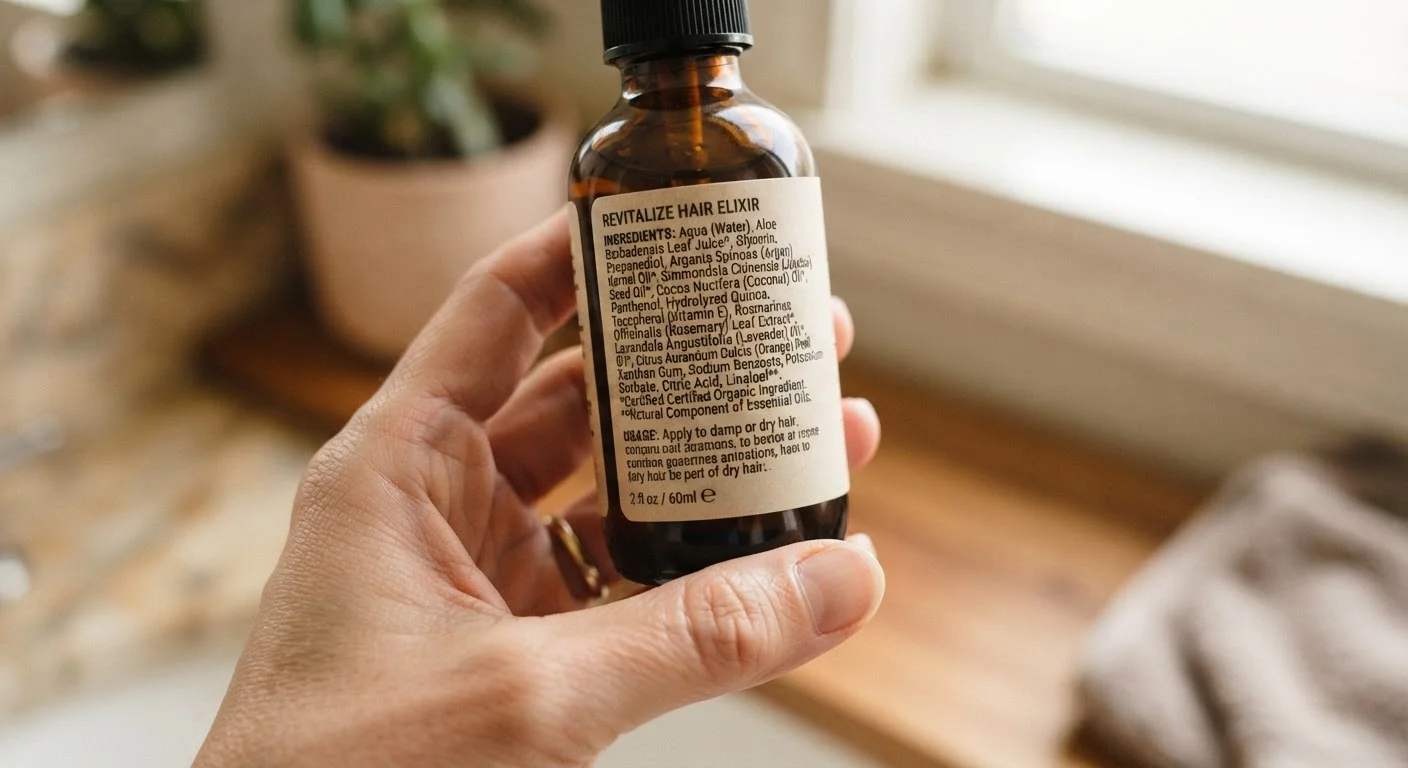
Flip any shampoo, conditioner, or leave-in to the back and you'll likely find a paragraph of chemical-sounding words that could pass for a lab report. Most of them are actually familiar substances - water, plant oils, proteins - listed under their INCI names (International Nomenclature of Cosmetic Ingredients), a standardized Latin-and-English system used across the beauty industry. That's why "water" might appear as Aqua and coconut oil might read as Cocos Nucifera Oil.
The most important rule: ingredients are listed in descending order by concentration. What appears near the top makes up the bulk of the formula. What appears near the bottom - especially below 1% - is present in a smaller amount. This ordering is your first tool for cutting through the noise.
For a broader look at how this same logic applies to skincare, see our guide to reading skincare ingredient lists.
| Ingredient listing rule | Descending order by concentration (U.S. FDA requirement) (U.S. Food & Drug Administration) |
| Naming system used | INCI - International Nomenclature of Cosmetic Ingredients (Personal Care Products Council) |
| 1% threshold | Ingredients below 1% concentration may be listed in any order (FDA labeling regulations) |
| Common moisturizing agents | Glycerin, panthenol, aloe vera juice |
| Protein signal word | "Hydrolyzed" before a protein name indicates smaller, penetrating molecules |
| Fatty vs. short-chain alcohols | Fatty alcohols (cetyl, stearyl) condition; short-chain (isopropyl) may dry |
Spotting the Key Ingredient Categories
Once you know what role each ingredient plays, labels become much easier to scan. Here are the main categories to look for:
Moisturizers and Humectants
These attract and hold water in the hair shaft. Common examples include glycerin, aloe vera (Aloe Barbadensis Leaf Juice), and panthenol (a form of vitamin B5). If your hair tends toward dryness, seeing these near the top of a formula is a positive sign.
Proteins
Proteins temporarily fill gaps in damaged or porous hair, improving strength and smoothness. You'll see them listed as hydrolyzed keratin, hydrolyzed wheat protein, hydrolyzed silk, or hydrolyzed quinoa. The word "hydrolyzed" means the protein has been broken into smaller molecules that can actually penetrate the hair strand.
Emollients and Oils
Oils seal the cuticle and add shine. Look for ingredients like Argania Spinosa Kernel Oil (argan oil), Simmondsia Chinensis Seed Oil (jojoba oil), or shea butter (Butyrospermum Parkii Butter). Lighter oils tend to appear as serums or leave-ins; heavier butters are more common in deep conditioners.
Surfactants
Surfactants do the cleansing work in shampoos. Some, like sodium lauryl sulfate (SLS) and sodium laureth sulfate (SLES), can be drying or irritating for some hair types. Milder alternatives include cocamidopropyl betaine or sodium cocoyl isethionate. Our sulfate-free vs. traditional shampoo breakdown goes deeper on this distinction.
INCI
International Nomenclature of Cosmetic Ingredients - a standardized, globally recognized system for naming cosmetic and personal care ingredients. It uses Latin botanical names for plant extracts and systematic chemical names for synthetic compounds.
Humectant
An ingredient that draws moisture from the environment or deeper layers into the hair shaft. Glycerin and aloe vera are common humectants in hair care.
Hydrolyzed protein
A protein broken down into smaller molecular fragments that can penetrate the hair cuticle. Used to temporarily strengthen and smooth the hair strand.
Surfactant
A surface-active agent that lowers surface tension between water and oil, allowing cleansing. Shampoos rely on surfactants to lift dirt, sebum, and product buildup from the hair.
Emollient
An ingredient that softens and smooths the hair by filling gaps in the cuticle and reducing friction. Plant oils and fatty alcohols commonly serve as emollients.
Silicone
A family of synthetic compounds (often ending in "-cone" or "-siloxane") that coat the hair to add slip, shine, and heat protection. Water-insoluble silicones may require a clarifying shampoo to fully remove.
Ingredients Worth Watching
"Watching" doesn't mean avoiding - it means being informed. A few ingredients that commonly raise questions:
- Fragrance / Parfum: A catch-all term that can contain dozens of undisclosed compounds. For people with sensitive scalps, fragrance is worth noting. Our look at fragrance in beauty products explores both sides of this debate.
- Silicones (e.g., dimethicone, cyclomethicone): These coat the hair for smoothness and heat protection. They're not inherently harmful, but they can build up over time without a clarifying wash.
- Formaldehyde-releasing preservatives (e.g., DMDM hydantoin, quaternium-15): These are used in low concentrations to prevent microbial growth. Some people prefer to limit them, particularly if they have a sensitive scalp - see our scalp care guide for context on scalp sensitivity.
- Alcohols: Not all alcohols are drying. Short-chain alcohols (like isopropyl alcohol) can be drying in large amounts, while fatty alcohols (cetyl alcohol, stearyl alcohol) are actually emollient and conditioning.
Understanding which ingredients work well together - and which don't - is the next step. Our article on hair ingredient pairings covers exactly that.
Patch Testing Still Applies to Hair Products
If you have a sensitive scalp or known allergies, doing a small patch test before fully applying a new product is a sensible step. Apply a small amount to your inner arm or behind your ear and wait 24 hours to check for any reaction. This is especially useful when trying formulas with fragrance, essential oils, or preservatives. See our product readiness checklist for a practical approach.