

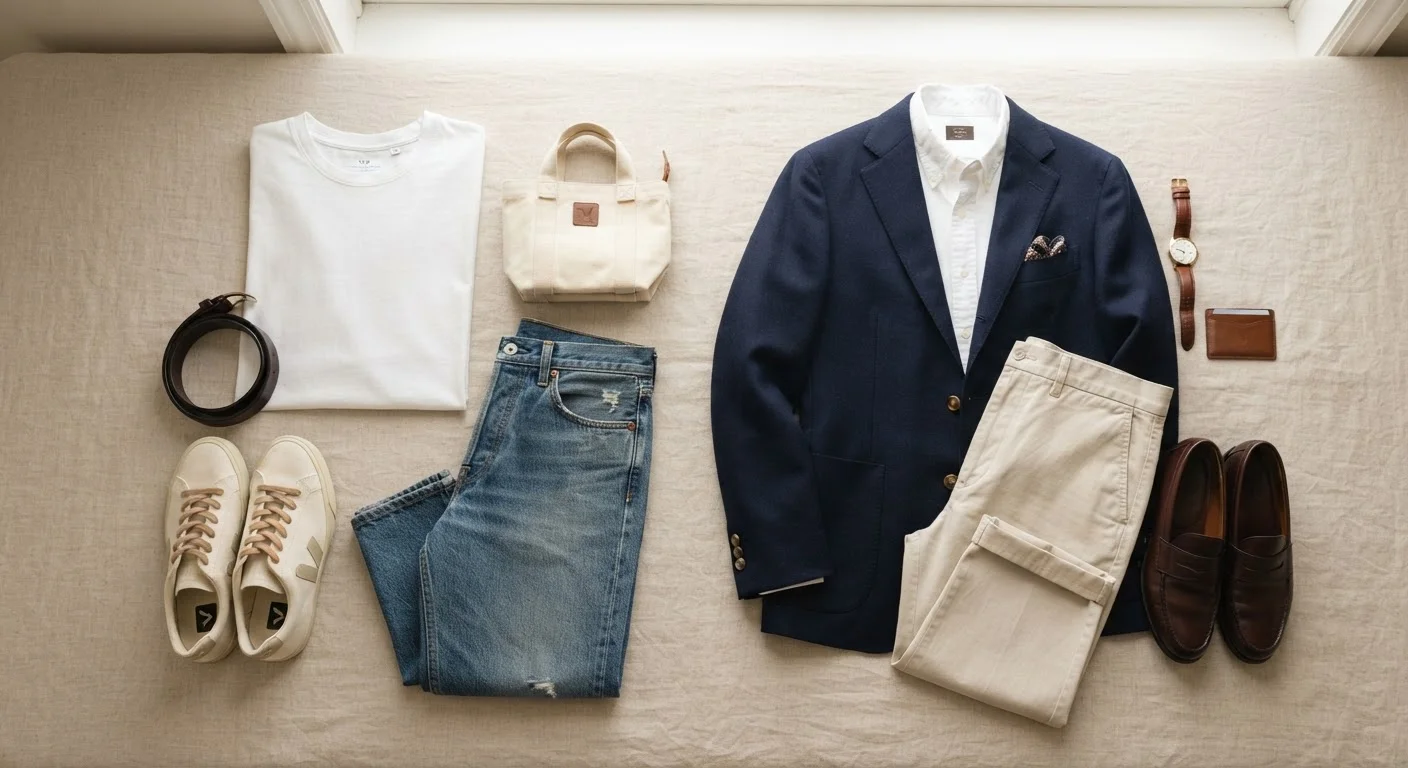
Key Takeaways
- Casual prioritizes comfort and ease; smart casual adds intention, fit, and a degree of polish.
- Smart casual is not business casual - it sits between the two and allows more personality.
- Fit is the single most important factor that elevates casual clothing into smart casual territory.
- Footwear and fabric quality are reliable signals of which dress code you're aiming for.
- Most American dress codes that say 'smart casual' expect you to look put-together, not formal.
Option A
Casual
The relaxed, no-fuss everyday default.
Best for: Low-key settings where comfort is the primary goal and appearance is secondary - weekends, errands, and informal hangouts.
Option B
Smart Casual
The polished-but-approachable middle ground.
Best for: Social or professional settings that call for effort and intentionality without the formality of business attire.
If you're heading out for a casual weekend brunch with close friends
Casual
A relaxed environment with no performance expectations is exactly where casual dressing belongs - comfortable, unfussy, and pressure-free.
If you're attending a work social event, date night, or a friend's dinner party
Smart Casual
These settings reward a little effort. Smart casual shows awareness of the occasion without overdressing.
If the invitation or venue says 'smart casual' and you're unsure
Smart Casual
When in doubt, err toward polish. It's much easier to remove a blazer or roll up sleeves than to feel underdressed with no alternatives.
If you're building a versatile wardrobe that works across multiple settings
Smart Casual
Smart casual staples - well-fitted trousers, clean leather shoes, structured tops - flex down toward casual more easily than they flex up toward formal.
What Each Term Actually Means
Dress codes in the United States have never been perfectly standardized, and "casual" versus "smart casual" is one of the most commonly misread distinctions. Understanding the difference isn't about memorizing rules - it's about recognizing the underlying intention behind each category.
Casual is the default mode for most Americans outside of work. Think jeans, sneakers, graphic tees, hoodies, and sandals. The emphasis is on personal comfort. There's no expectation that items coordinate, fit precisely, or signal any particular effort. Casual clothing is worn to run errands, watch a game, or meet up with friends informally. It's not sloppy by definition - clean, well-maintained casual clothing is still casual - but the standard is relaxed.
Smart casual, by contrast, asks you to meet the occasion halfway. It keeps the comfort and personality of casual dressing while adding intentionality: clothing that fits well, coordinates deliberately, and signals that you thought about what you put on. A pair of dark, well-fitted jeans can cross from casual into smart casual when paired with a crisp button-down and leather shoes. The same jeans in a worn wash with sneakers and a logo tee stay firmly in casual territory.
For a broader view of how these categories fit within the full spectrum of American dress codes, see this plain-language breakdown.
How to Tell the Difference in Practice
The clearest way to identify which category an outfit belongs to is to look at three things: fit, fabric, and footwear.
| Criterion | Casual | Smart Casual |
|---|---|---|
| Fit expectation | Relaxed, comfort-driven | Intentional, well-fitted |
| Typical tops | T-shirts, hoodies, sweatshirts | Collared shirts, blouses, structured knits |
| Typical bottoms | Worn jeans, joggers, shorts | Dark jeans, chinos, tailored trousers, skirts |
| Footwear | Athletic sneakers, sandals, flip-flops | Loafers, leather sneakers, boots, flats |
| Fabric feel | Jersey, fleece, athletic materials | Woven cotton, linen, wool blends |
| Occasion examples | Errands, weekend hangouts | Dinner parties, work socials, date nights |
| Coordination expected? | Not really | Yes - coherent outfit matters |
Fit is the most powerful variable. Clothes that fit the body - not too tight, not shapeless - read as intentional regardless of how simple they are. A plain white shirt in a good fit can anchor a smart casual look. The same shirt three sizes too large skews casual. If you're curious about how to think about fit without outdated body-type frameworks, this guide on fit and proportion offers a practical perspective.
Fabric matters more than most people realize. Cotton jersey, fleece, and athletic fabrics read casual even when cut cleanly. Woven fabrics - cotton poplin, lightweight wool, linen blends - carry more structure and naturally elevate an outfit. Understanding how fabrics behave helps you make smarter choices without spending more.
Footwear is often what seals or undermines a smart casual look. Chunky athletic sneakers, flip-flops, or heavily worn shoes tend to anchor an outfit in casual territory. Clean leather sneakers, loafers, Chelsea boots, or low-profile dress shoes shift the register upward immediately.
#1
Factor that elevates a casual outfit
Fit consistently ranks as the most cited element separating polished from underdressed looks, according to fashion industry style guides and wardrobe consultants.
~60%
Americans unsure what smart casual means
Surveys on dress code literacy suggest a majority of Americans feel uncertain about how to interpret smart casual invitations, often defaulting to either too casual or too formal.
Common Mistakes - and How to Avoid Them
The most frequent mistake people make is assuming smart casual means "slightly more formal casual" - so they just swap the sneakers for boots and call it done. Smart casual is less about swapping one item and more about the overall coherence of the outfit.
Smart Casual Is Not a Fixed Formula
What qualifies as smart casual can shift based on region, industry, age group, and the specific event. A smart casual wedding in Nashville may look different from a smart casual work event in Seattle. When in doubt, consider the host, the venue, and the overall vibe of the occasion - not just the label. Erring slightly toward polish is almost always the safer call.
Another common error is conflating smart casual with business casual. Business casual generally expects collared shirts, trousers or structured chinos, and closed-toe shoes - it's workplace-oriented. Smart casual is social-oriented and allows more flexibility: a well-chosen sweater, a patterned shirt, expressive accessories. The vibe is put-together rather than corporate.
Finally, people sometimes overcorrect and overdress for a smart casual occasion, arriving in a full suit or cocktail attire when the setting didn't call for it. Overdressing can create as much social friction as underdressing in casual-leaning environments. When an invitation specifies smart casual, take it at face value.
If you're working on building outfits that reliably hit the smart casual mark, outfit formulas are a low-effort way to build that confidence. And if you're unsure your current wardrobe has the right pieces, a closet audit can help you identify what's actually earning its space.