

Key Takeaways
- Outfit formulas are repeatable clothing combinations that remove daily decision fatigue.
- A formula works best when built around pieces you already own and regularly wear.
- Most reliable formulas follow a simple structure: a base, a layer, and a grounding element.
- Adapting one formula across different settings saves time without sacrificing polish.
- Fit and proportion matter more than trend-chasing when building go-to combinations.
Why Formulas Work Better Than Rules
Getting dressed shouldn't feel like a problem to solve every morning. Yet for many people, standing in front of a full closet and coming up empty is a daily frustration - not because they lack clothes, but because they lack structure. That's where outfit formulas come in.
An outfit formula is a repeatable combination - a framework of clothing elements that works reliably across different pieces and occasions. Think of it less like a uniform and more like a recipe: once you understand the ratios, you can swap the ingredients without losing the result.
Unlike rigid rules about what colors "go together" or what shapes flatter which body type, formulas are adaptable. They acknowledge that dressing well isn't about perfection - it's about consistency and ease. If you're building your foundational wardrobe from the ground up, our guide on building a versatile wardrobe from scratch pairs well with the formulas below.
Here are seven proven outfit structures that work in the real world - across body types, budgets, and lifestyles.
The Tonal Stack
Wearing different shades of the same color family from head to toe creates an instantly polished, pulled-together look with almost no effort. A camel sweater over cream trousers with tan loafers, for example, reads as intentional rather than accidental.
The key is varying texture to keep the look interesting - a chunky knit over smooth pants, or matte over sheen. This formula travels well across casual and smart-casual settings and is particularly forgiving for mornings when decision-making energy is low.
Tonal dressing looks intentional with minimal effort - texture does the work variation.
Dark Jeans + Tucked Top + One Layer
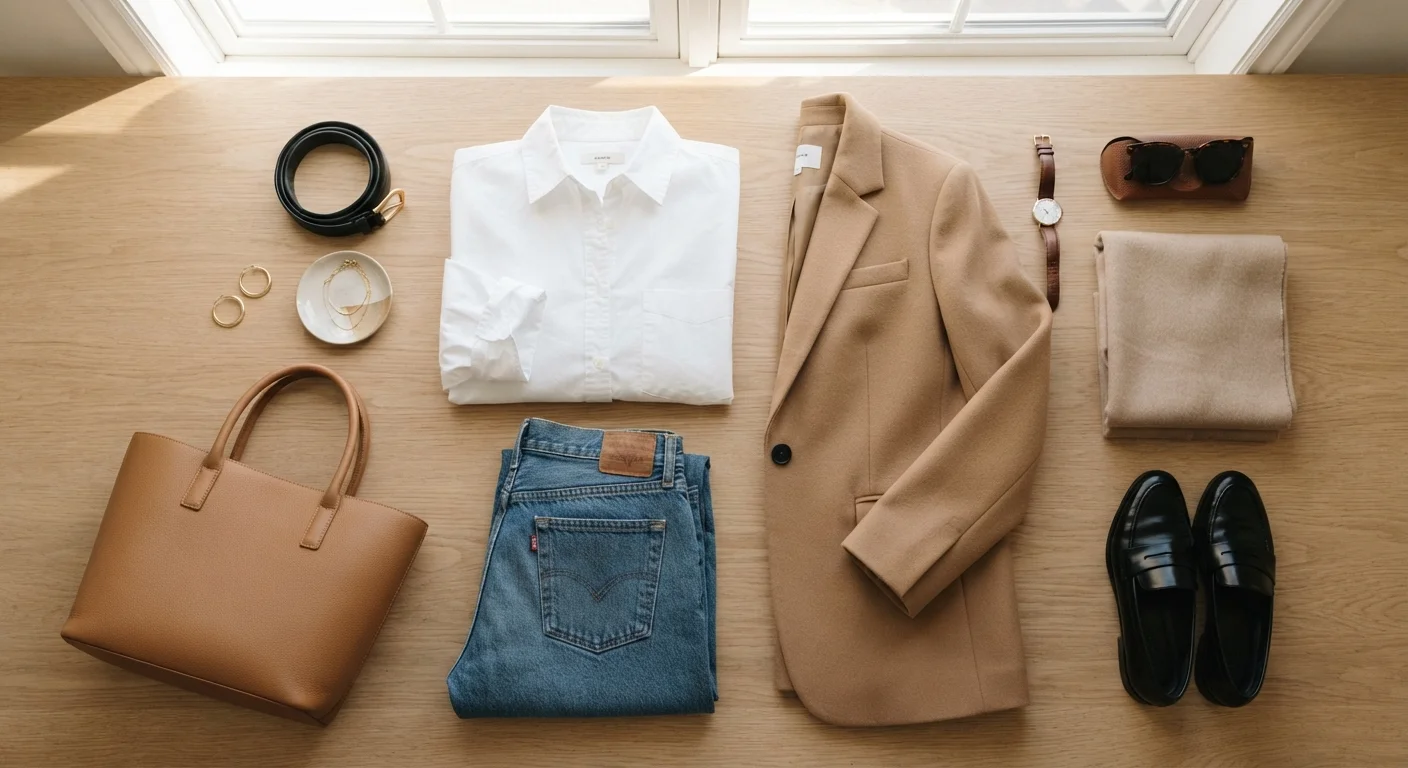
This three-part structure is one of the most versatile formulas in everyday dressing. Dark-wash denim serves as a neutral base, a tucked-in top (whether a button-down, a fitted tee, or a blouse) adds shape, and a single outer layer - a blazer, denim jacket, or cardigan - pulls it together.
The formula works because each element does a specific job: the jeans ground the look, the tuck creates proportion, and the layer adds polish. Swap the layer for context - a structured blazer for a work meeting, a relaxed overshirt for a weekend errand run.
Each element has a job: ground, shape, polish - swapping the layer shifts the occasion.
The Monochrome + Contrast Shoe Formula
Dress head-to-toe in a single neutral - navy, grey, olive, or black - and then let your footwear do the talking. A white sneaker against an all-black outfit, or a cognac boot under an all-grey look, creates a visual anchor without requiring any other accessories.
This formula is especially useful for those who find accessorizing overwhelming. The shoe becomes the decision, and the rest largely takes care of itself. It also works across genders and a wide range of body types.
Let your footwear be the single statement - the rest of the outfit takes care of itself.
Relaxed Bottom + Fitted Top (or Vice Versa)
Balancing volume is one of the most reliable principles in everyday dressing - and this formula puts it into action. When your bottom half is loose (wide-leg trousers, a flowy skirt, relaxed joggers), anchor it with a more fitted top. When your top half is oversized or draped, ground it with a slim or tapered pant.
This proportion principle creates visual balance without requiring a specific body type or silhouette. It's a framework that works across seasons and styles - from a boxy linen shirt over slim chinos in summer to an oversized crewneck over straight-leg denim in fall.
Balance volume on one end with a fitted piece on the other - proportion does the heavy lifting.
The "Third Piece" Trick
If an outfit feels incomplete, adding a third element almost always solves it. The third piece can be a scarf, a belt, a hat, a structured bag, or even untucking a shirttail. It doesn't need to be significant - it just needs to interrupt the visual flatness of a two-item outfit.
This formula is less about what the piece is and more about the layering logic. Two items can look like you got dressed; three items look like you thought about it. For those working with a tighter clothing budget, accessories are often the most cost-effective way to extend the range of what you own - a concept explored further in our guide on dressing well on a tight budget.
Two items look like you got dressed; three items look like you thought about it.
Neutral Base + One Color Anchor
Build the outfit in neutrals - white, grey, black, navy, beige - then introduce a single color through one item or accessory. That one color becomes the intentional choice that elevates everything else around it.
This formula is particularly useful for people who love color but feel unsure how to use it. Because the base is neutral, the color anchor never fights with anything else. A terracotta bag, a forest green scarf, a cobalt blue sweater - any of these can transform a neutral outfit into something memorable without requiring a full style rethink.
One color anchor in a neutral outfit is all the interest you need - and it's hard to get wrong.
Dress + Sneaker (or Boot) for Instant Cross-Context Dressing
Pairing a dress or a skirt with athletic or casual footwear is one of the most effective ways to shift an outfit's register - making something that might read as dressy feel grounded and approachable. Conversely, a simple slip dress with ankle boots reads polished without being formal.
This formula challenges the idea that dresses are only for dressier occasions. A midi dress with white sneakers works for school pickup, a lunch meeting, and a casual dinner. The footwear does the contextual calibration. If you're thinking more broadly about how your closet fits together, the capsule wardrobe concept offers a useful framework for choosing pieces that support formulas like this one.
Footwear calibrates context - a dress with sneakers can go almost anywhere.
Making These Formulas Your Own
The power of a formula is in the repetition - but repetition doesn't mean monotony. Once a combination clicks for you, you can shift the color palette, swap in seasonal fabrics, or adjust the silhouette while keeping the underlying structure intact.
Start with What You Already Have
Before experimenting with a new formula, scan your existing wardrobe for pieces that already fit the structure. Most people find at least two or three formulas are already working in their closet without them realizing it. Identifying those patterns first makes it easier to build on them intentionally rather than starting over.
It also helps to run a closet audit before committing to any formula. Knowing what you actually reach for - versus what's just taking up space - helps you identify which formulas are already working in your life and which pieces might be worth adding. Fit and proportion are worth paying attention to as well; our piece on dressing for your body shape separates the genuinely useful guidance from advice that's overdue for retirement.
Outfit formulas aren't about limiting creativity - they're about freeing up mental energy for the parts of your day that actually need it.