

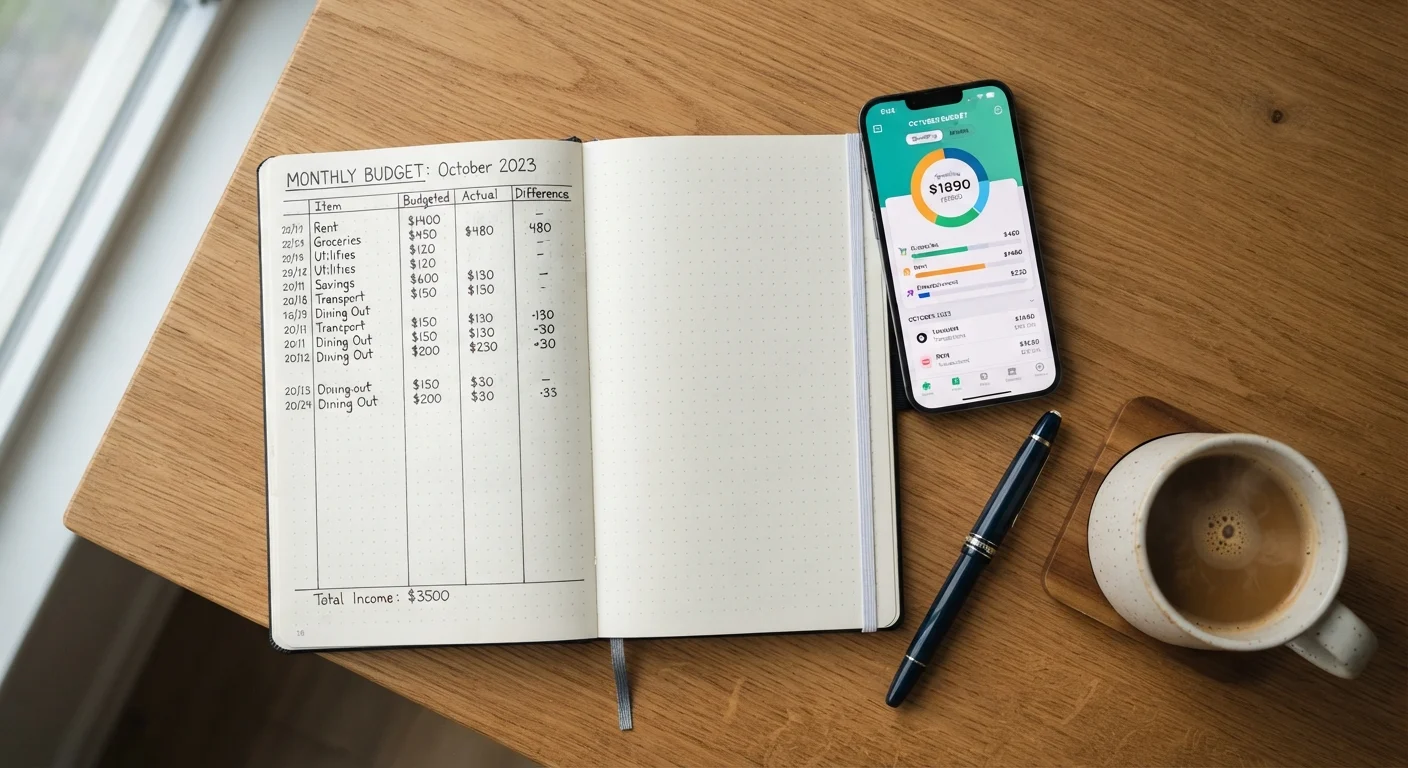
Key Takeaways
- Manual tracking builds deeper spending awareness but requires consistent daily effort.
- Budgeting apps automate data collection but introduce privacy and subscription trade-offs.
- Neither method is universally superior - your habits and goals determine the better fit.
- Many people find combining both approaches produces the most lasting financial discipline.
Builds deliberate awareness with every transaction recorded
Writing down each purchase creates a brief moment of reflection that automated systems skip entirely. This friction is a feature - it makes spending feel more real and consequential.
No account access or data-sharing required
Manual tracking eliminates the privacy risk of sharing banking credentials with third-party apps. Your financial data stays entirely within your control.
Fully customizable categories and logic
You define what every category means and can adjust instantly - no waiting for an app update or fighting with an algorithm's assumptions about your lifestyle.
Zero cost beyond a notebook or free spreadsheet
There are no subscription fees, premium tiers, or in-app upsells. A simple notebook or a free spreadsheet tool gets the job done with no ongoing expense.
Requires daily discipline to stay accurate
Missing even a few days can create gaps that distort your overall picture. People with irregular schedules often find manual tracking hard to sustain long-term.
Privacy and data security trade-offs
Most apps require access to your bank accounts via third-party data aggregators, and free apps may monetize your anonymized spending data through advertising or partner relationships.
Subscription fees add a real ongoing cost
Many full-featured budgeting apps charge between $5 and $15 per month. For a household already watching every dollar, that's a cost worth factoring into the decision.
Automatic categorization errors create extra work
Apps frequently miscategorize transactions - a grocery stop at a big-box retailer might log as "Shopping" rather than "Food." Correcting these errors manually can offset the time savings of automation.
Our Verdict
Manual tracking suits people who want deliberate, friction-rich engagement with their money and are willing to invest a few minutes each day. Budgeting apps work better for those who need automation to stay consistent and don't mind granting financial account access to third-party software. Both methods can meaningfully improve financial awareness - the one you'll actually stick with is the right one.
Manual tracking is ideal for detail-oriented individuals or those wary of data sharing; apps suit busy households that prioritize convenience and real-time visibility.
Why How You Track Spending Actually Matters
Tracking spending is one of the most foundational budgeting habits - yet most people either abandon it within weeks or never start. The method you choose plays a surprisingly large role in whether the habit sticks. Manual tracking and app-based tracking aren't just different tools; they create different relationships with your money.
Manual methods - notebooks, spreadsheets, cash envelopes - require you to actively record each transaction. Apps connect to your bank accounts and credit cards, pulling in data automatically. Both produce the same basic output (a record of where your money goes), but the cognitive experience is very different. For a broader look at how different budgeting systems compare, see budgeting methods compared.
The Case for Tracking by Hand
Writing down every transaction - even if it takes two minutes a day - forces a level of attention that automation simply cannot replicate. Researchers in behavioral finance have long noted that friction in financial decisions tends to increase mindfulness, not reduce effectiveness.
Builds deliberate awareness with every transaction recorded
Writing down each purchase creates a brief moment of reflection that automated systems skip entirely. This friction is a feature - it makes spending feel more real and consequential.
No account access or data-sharing required
Manual tracking eliminates the privacy risk of sharing banking credentials with third-party apps. Your financial data stays entirely within your control.
Fully customizable categories and logic
You define what every category means and can adjust instantly - no waiting for an app update or fighting with an algorithm's assumptions about your lifestyle.
Zero cost beyond a notebook or free spreadsheet
There are no subscription fees, premium tiers, or in-app upsells. A simple notebook or a free spreadsheet tool gets the job done with no ongoing expense.
Manual tracking also gives you complete control over categorization. You decide what counts as "dining out" versus "groceries," and you can adjust those definitions as your situation changes without waiting for an algorithm to catch up. It's also worth noting that no notebook has a data breach.
The downside is consistency. Life gets busy, receipts disappear, and a week of missed entries can undermine the entire record. Manual tracking works best for people with predictable spending patterns, those working to break a specific bad habit, or anyone who finds that writing things down helps them process information more deeply.
The Case for Using a Budgeting App
Apps remove the biggest barrier to tracking: remembering to do it. By connecting directly to your financial accounts, they capture transactions in near-real time - including ones you'd never think to jot down, like an automatic subscription renewal or a small ATM fee.
Requires daily discipline to stay accurate
Missing even a few days can create gaps that distort your overall picture. People with irregular schedules often find manual tracking hard to sustain long-term.
Privacy and data security trade-offs
Most apps require access to your bank accounts via third-party data aggregators, and free apps may monetize your anonymized spending data through advertising or partner relationships.
Subscription fees add a real ongoing cost
Many full-featured budgeting apps charge between $5 and $15 per month. For a household already watching every dollar, that's a cost worth factoring into the decision.
Automatic categorization errors create extra work
Apps frequently miscategorize transactions - a grocery stop at a big-box retailer might log as "Shopping" rather than "Food." Correcting these errors manually can offset the time savings of automation.
The automation also enables useful features: spending trend charts, category alerts, and progress toward savings goals. If you're working to grow an emergency fund or reduce debt, these visual cues can reinforce positive behavior over time. For goal-setting context, the Saving & Goals hub covers building financial targets from the ground up.
~1 in 3
Americans without a working budget
Surveys by the National Foundation for Credit Counseling have consistently found that a significant share of U.S. adults do not keep a detailed monthly budget of any kind.
$5-$15/mo
Typical cost of premium budgeting apps
Many widely used budgeting apps charge monthly or annual subscription fees, a real consideration for households focused on cutting unnecessary expenses.
The trade-offs, however, deserve honest attention. Most apps require you to share your banking credentials or grant read access through a third-party data aggregator. Privacy policies vary significantly, and free apps often monetize your anonymized spending data or upsell premium features. Subscription costs for paid apps can range from roughly $5 to $15 per month - a real line item for budget-conscious households.
Apps also tend to miscategorize transactions (a gas station purchase logged as "Automotive" instead of "Food" because you bought a snack), and correcting these errors manually can feel like its own chore.
A Note on App Data Practices
When an app connects to your bank, it typically routes through a financial data aggregator - a third-party service that manages credential storage and data transmission. Before linking any account, review the app's privacy policy to understand how your data is stored, shared, and whether it is sold in anonymized form. Policies vary widely across providers, and the specifics matter more than the app's general reputation.
Choosing What Works for Your Financial Life
The most effective tracking method is the one you'll use consistently. A few questions can help clarify which approach fits your situation better:
- How variable is your spending? Highly variable, cash-heavy lifestyles are harder for apps to capture accurately - manual tracking may be more reliable.
- How much do you value privacy? If connecting financial accounts to third-party software concerns you, a spreadsheet or notebook removes that risk entirely. For a parallel look at how app-based convenience always involves trade-offs, see the trade-offs of using apps.
- Do you need real-time visibility? If overspending on a category mid-month is a recurring problem, app alerts can catch issues before they compound.
- Are you managing debt alongside your budget? Apps that integrate net worth and debt payoff tracking may add value - the Debt & Credit hub outlines strategies that pair well with either tracking approach.
Some households use both: a quick daily log in a notebook for mindfulness, plus an app as a backup audit. Neither method is a substitute for a broader financial plan, but either one - used honestly - builds the spending awareness that makes every other financial goal more achievable.
This article is for general informational and educational purposes only and does not constitute personalized financial advice. Consult a qualified financial professional for guidance specific to your situation.