

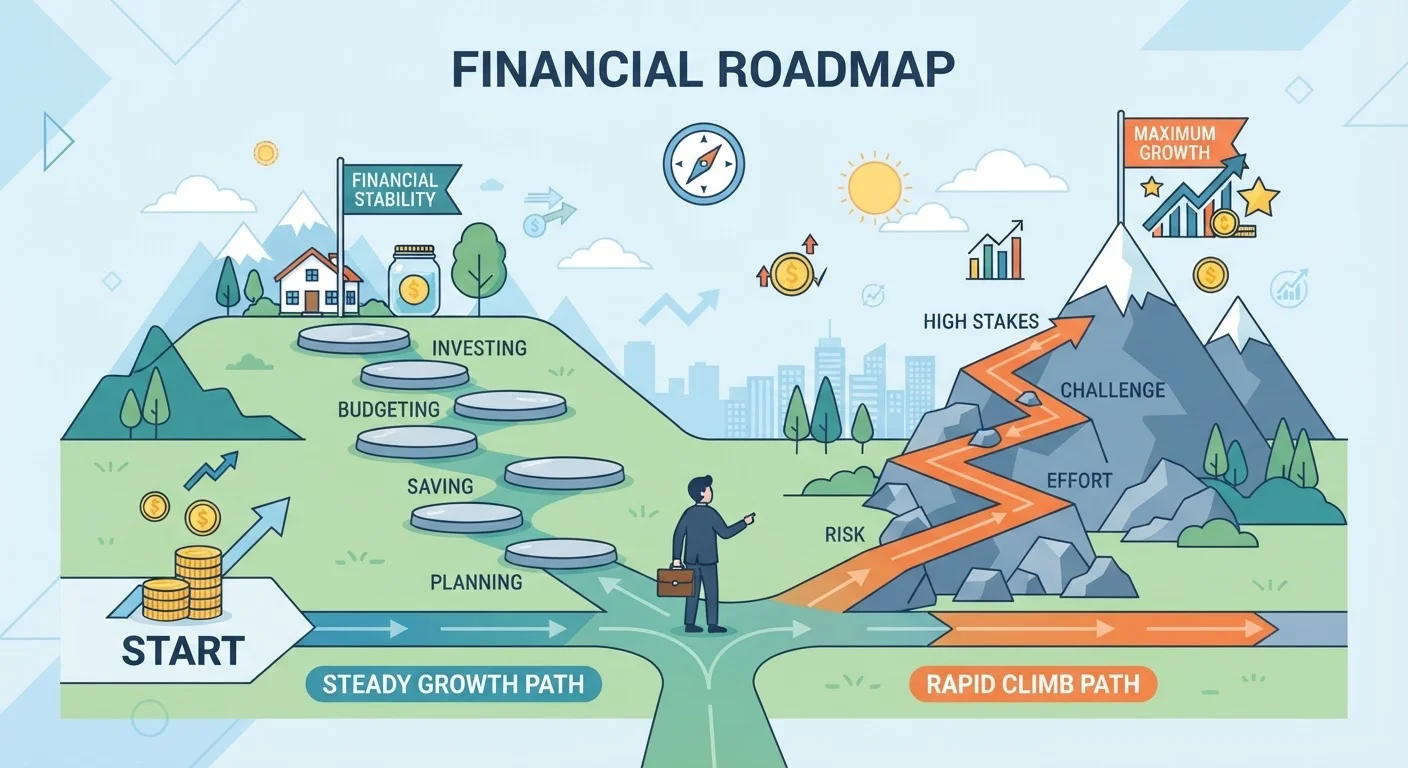
Key Takeaways
- The debt snowball pays off the smallest balances first to build momentum through early wins.
- The debt avalanche targets the highest-interest debt first, typically reducing total interest paid.
- Neither method requires extra income - both rely on redirecting existing payments strategically.
- Behavioral factors matter: the method you stick with consistently is more effective than the theoretically optimal one you abandon.
- Both strategies work best when paired with a realistic budget that frees up extra money for debt repayment.
Option A
Debt Snowball
The motivation-first approach to eliminating debt.
Best for: People who need early wins to stay engaged and consistent with their repayment plan.
Option B
Debt Avalanche
The mathematically efficient route to becoming debt-free.
Best for: People who are disciplined and focused on minimizing the total interest paid over time.
If you've struggled to stay motivated with debt repayment in the past
Debt Snowball
Eliminating smaller balances quickly creates a sense of progress that can sustain long-term commitment.
If you carry high-interest debt such as credit cards with rates above 20%
Debt Avalanche
Targeting high-interest accounts first reduces the amount of interest accumulating each month, saving money over time.
If your debts are similar in balance but vary widely in interest rate
Debt Avalanche
When balances are comparable, tackling the highest-rate debt delivers meaningful interest savings without sacrificing much early momentum.
If you have many small accounts cluttering your financial life
Debt Snowball
Closing out small accounts quickly simplifies your finances and reduces the number of payments to track each month.
If you are unsure which method fits your personality
Debt Snowball
Research on financial behavior suggests that visible progress is a reliable predictor of sustained repayment effort for most people.
How Each Method Works
Both the debt snowball and the debt avalanche are structured repayment frameworks designed to eliminate multiple debts systematically. The core mechanic is the same: you make minimum payments on all accounts, then direct any additional funds toward one target debt at a time. What differs is how that target is chosen.
Debt Snowball: You rank your debts from the smallest balance to the largest, regardless of interest rate. Extra payments go toward the smallest balance first. Once it's paid off, you roll that freed-up payment amount into the next-smallest debt - creating a growing "snowball" of payment power as you go.
Debt Avalanche: You rank debts from the highest interest rate to the lowest. Extra funds go toward the highest-rate account first. Once eliminated, that payment cascades to the next-highest-rate debt. Because you're retiring the most expensive debt first, less interest accumulates across your total balance over time.
Neither approach requires you to earn more money. Both rely on the discipline of consistently applying the same payment behavior until debts are cleared. For a broader view of organizing multiple accounts, see strategies for managing debt across multiple accounts.
| Criterion | Debt Snowball | Debt Avalanche |
|---|---|---|
| Repayment order | Smallest balance first | Highest interest rate first |
| Total interest paid | Typically higher | Typically lower |
| Time to first payoff | Often faster | Often slower |
| Psychological motivation | High - quick early wins | Lower - slower visible progress |
| Complexity | Simple to follow | Requires tracking rates |
| Best scenario | Many small balances | High-rate debt dominates |
The Math: Which Saves More Money?
In nearly all scenarios, the debt avalanche saves more money in total interest paid. By neutralizing high-rate balances early, you slow the rate at which interest compounds across your accounts. The difference can be modest or significant depending on the gap between your highest and lowest interest rates and the size of your balances.
~$1,000+
Potential interest saved with avalanche method
Estimates vary widely by balance size and rate spread, but financial planners commonly illustrate savings of hundreds to thousands of dollars depending on the debt profile.
3-6 months
Typical time to first snowball payoff
For borrowers with at least one small balance under $1,000, the snowball method often produces a first payoff within a few months when extra payments are applied consistently.
However, the mathematical advantage of the avalanche only materializes if you follow it consistently over months or years. If a method feels discouraging and leads to abandonment, the theoretical savings never appear. That's why behavioral economics researchers have found that the snowball method - despite its mathematical inefficiency - can produce better real-world results for many people because it sustains follow-through.
If your debts carry similar interest rates, the practical difference between the two methods may be small. In that case, personal preference and psychological fit matter more than formula.
Motivation and Behavior: The Hidden Variable
The debt snowball was popularized in part because it acknowledges that personal finance is deeply behavioral. When you pay off a $400 medical bill or a small store credit card, you experience a concrete win. That account is gone, the payment is freed up, and your debt list gets shorter. For many people, that momentum is not a small thing - it's what keeps the plan alive.
The debt avalanche demands more patience. Your highest-interest debt may also be your largest balance, which means months of payments before you see an account closed. If you're the kind of person who tracks a spreadsheet, watches interest charges drop, and finds that satisfying, the avalanche approach may suit you well. If you need visible milestones to stay engaged, the snowball likely serves you better.
A useful exercise: list your debts, note the balances and rates, and estimate how long it would take to pay off the first target under each method. If the avalanche approach means waiting 18 months to close your first account while the snowball closes one in three months, that timeline difference is relevant data about which plan you're more likely to sustain.
Whichever method you choose, it works best inside a functioning budget. See budgeting methods compared for practical frameworks that free up the extra cash these strategies depend on.
Combining, Adapting, and Alternatives
The snowball and avalanche aren't mutually exclusive in practice. Some people use a hybrid: they pay off one or two small "quick win" accounts first to build confidence, then shift to tackling high-interest balances. This isn't a textbook strategy, but it reflects real behavior, and the most effective debt plan is the one you'll actually follow.
It's also worth knowing that debt repayment isn't the only approach to managing multiple debts. Debt consolidation combines multiple balances into a single loan, potentially at a lower interest rate. This can simplify repayment and reduce interest costs, but it carries its own considerations and risks worth evaluating carefully.
Understanding the nature of the debts you carry also helps. Secured and unsecured debts carry different risks and terms, which can influence which accounts you prioritize. Unsecured high-interest debt, such as credit cards, is often the most expensive to carry and frequently the right first target under either method.
Minimum Payments Still Matter
Regardless of which method you choose, always make at least the minimum payment on every account. Missing minimums triggers late fees, penalty interest rates, and credit score damage - all of which undermine your repayment plan. The extra funds beyond minimums are what you direct strategically under either approach.
This article is for general informational purposes only and does not constitute personalized financial advice. Consult a qualified financial professional for guidance tailored to your specific situation.