

Key Takeaways
- Overwhelm is normal - starting with one small area breaks the paralysis.
- You don't need a full weekend or a perfect plan to begin decluttering effectively.
- A simple keep-donate-discard system is all most beginners need to make real progress.
- Decluttering works best as a recurring habit, not a one-time event.
- Emotional attachment to objects is expected; work with it, not against it.
Start here
Why Decluttering Feels So Overwhelming
Next
The Beginner's Mindset: Start Small, Not Perfect
Then
Your First Decluttering Session: A Step-by-Step Approach
Apply it
Sorting Systems That Actually Work
Keep going
Building a Habit That Sticks
Why Decluttering Feels So Overwhelming
If standing in a cluttered room makes you want to close the door and walk away, you're not alone. For many people, the sheer volume of items - combined with decisions about every single one - triggers a kind of mental gridlock. Researchers who study decision-making sometimes call this decision fatigue: the more choices we face, the harder each subsequent one becomes.
There's also an emotional layer. Objects carry meaning - gifts from people we love, remnants of past chapters, things we paid good money for. Letting go of them can feel like a loss, even when the item itself serves no practical purpose anymore. Add in a busy schedule and the myth that decluttering requires a full, uninterrupted weekend, and avoidance starts to feel rational.
Understanding why it feels hard is the first step. The goal of this guide is to remove the all-or-nothing pressure and replace it with a realistic, low-stress process you can actually follow. If visual clutter is also making your space feel more chaotic than the item count alone explains, our piece on why rooms feel crowded even after removing furniture is worth a read alongside this one.
Decision fatigue
The mental exhaustion that comes from making many decisions in a row, which makes each subsequent choice harder and more draining.
Decluttering
The process of intentionally removing items from your home that you no longer use, need, or value, in order to create a more functional and calmer living space.
One-in, one-out rule
A simple habit where for every new item brought into your home, one comparable item is removed - keeping the overall volume of possessions stable.
Donation
Giving usable items - clothing, household goods, books - to a charity, thrift store, shelter, or community group where they can benefit someone else.
Decision paralysis
A state where someone is so overwhelmed by choices or the scale of a task that they struggle to take any action at all, often resulting in avoidance.
The Beginner's Mindset: Start Small, Not Perfect
The most common decluttering mistake beginners make is trying to do too much at once. Tackling an entire bedroom or garage in one session is a recipe for burnout and half-finished piles that feel worse than what you started with.
A more effective approach is to define your starting point as the smallest possible area you can complete in 15-20 minutes. One kitchen drawer. The top of a dresser. The floor of a closet. Finishing that area - actually finishing it - builds the confidence and habit loop that makes the next session easier.
Set a timer before you start
Committing to just 15 or 20 minutes removes the open-ended dread that stops many people from starting at all. When the timer goes off, you can choose to continue or stop - but you'll often find that starting was the hardest part. Even a partial session counts as real progress.
It also helps to reframe what success looks like. Decluttering isn't about achieving a magazine-ready home in one go. It's about making your daily life slightly easier and less mentally noisy. Progress, not perfection, is the correct measure. If you're also working on building better financial habits alongside a home reset, our beginner's budgeting guide uses a similar incremental approach that pairs well with this mindset.
Your First Decluttering Session: A Step-by-Step Approach
Follow these steps for your very first session, keeping it to a single contained area:
- Set a timer for 20 minutes. Knowing there's an endpoint reduces resistance before you even begin.
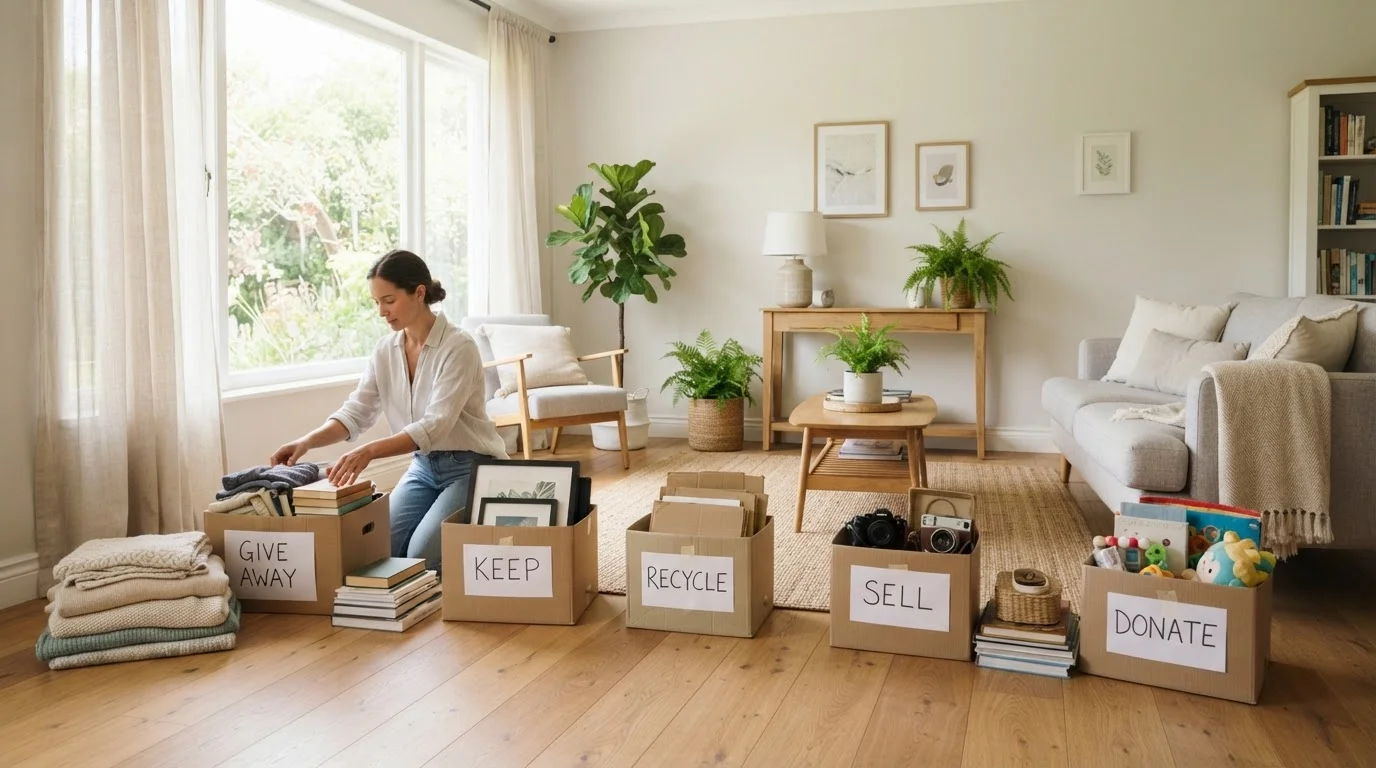
- Gather three containers. These can be boxes, bags, or baskets - label them Keep, Donate, and Discard. You don't need to buy anything new.
- Pick up each item once. Handle it, make a decision, and place it in one of the three containers. Avoid a fourth "maybe" pile - it becomes a permanent resting place for indecision.
- Return Keep items deliberately. Only put back items that genuinely belong in that space and that you use or value.
- Remove the Donate and Discard containers immediately. Bag them, put them by the door, or place them directly in your car. The faster they leave your home, the better.
Once you're comfortable with this process, our room-by-room decluttering walkthrough can help you scale it across your whole home systematically.
Sorting Systems That Actually Work
The three-container Keep/Donate/Discard system works for most situations, but there are a few additions that help when you get to trickier categories.
For clothing
A useful question is: Would I pick this up if I saw it in a store today? If the answer is no, it's a candidate for donation. For more structured thinking about what to keep versus release, our guide on building a versatile wardrobe from scratch offers useful framing.
For kitchen and pantry items
Duplicates are the biggest culprit in kitchen clutter. Most households don't need four spatulas or three can openers. Keep the one you actually reach for. For broader kitchen organization - including fridge and freezer - see our practical guide to food storage organization.
For sentimental items
Designate one physical container - a box, a bin, a shelf - as your sentimental limit. When it's full, something has to come out before something new goes in. This prevents the category from expanding indefinitely while still honoring what matters to you.
Don't organize before you declutter
Buying bins, baskets, and drawer dividers before you've reduced your belongings is a common and costly mistake. You'll end up organizing things you don't actually need, and the containers themselves become clutter. Always declutter first, then assess what organizational tools - if any - are genuinely needed for what remains.
Building a Habit That Sticks
A single decluttering session is a good start, but clutter accumulates continuously. The homes that stay manageable over time are maintained with small, regular habits - not occasional overhauls.
Two practices make the biggest difference:
- The one-in, one-out rule: When a new item enters your home, one comparable item leaves. This keeps the total volume stable without requiring constant purges.
- Weekly 10-minute resets: Once a week, do a quick pass of your most-used spaces. Return items to their homes, identify anything that doesn't belong, and deal with it on the spot.
Some people find that pairing decluttering with another habit - like tidying during a weekly planning session - helps it stick. If you respond well to reflective practices, journaling for emotional clarity can be a useful companion tool for processing the feelings that sometimes surface when you're letting go of things.
Remember that decluttering is an ongoing process, not a destination. The goal is a home that supports your daily life - not one that's sterile or perfectly minimalist unless that's genuinely what you want. Small, consistent effort compounds into a meaningfully calmer living environment over time.
Room-by-Room Decluttering Walkthrough
Once you've mastered the basics, this room-by-room guide helps you apply a structured decluttering process throughout your entire home before redecorating.
Home Food Organization Guide
Tackle kitchen clutter specifically with this practical guide to organizing your pantry, fridge, and freezer - reducing food waste and simplifying meal prep.
Donation Locator (local search)
Use a local charity or thrift store locator (search your city name plus "donation drop-off") to find the nearest place to take your gently used items quickly.