

Key Takeaways
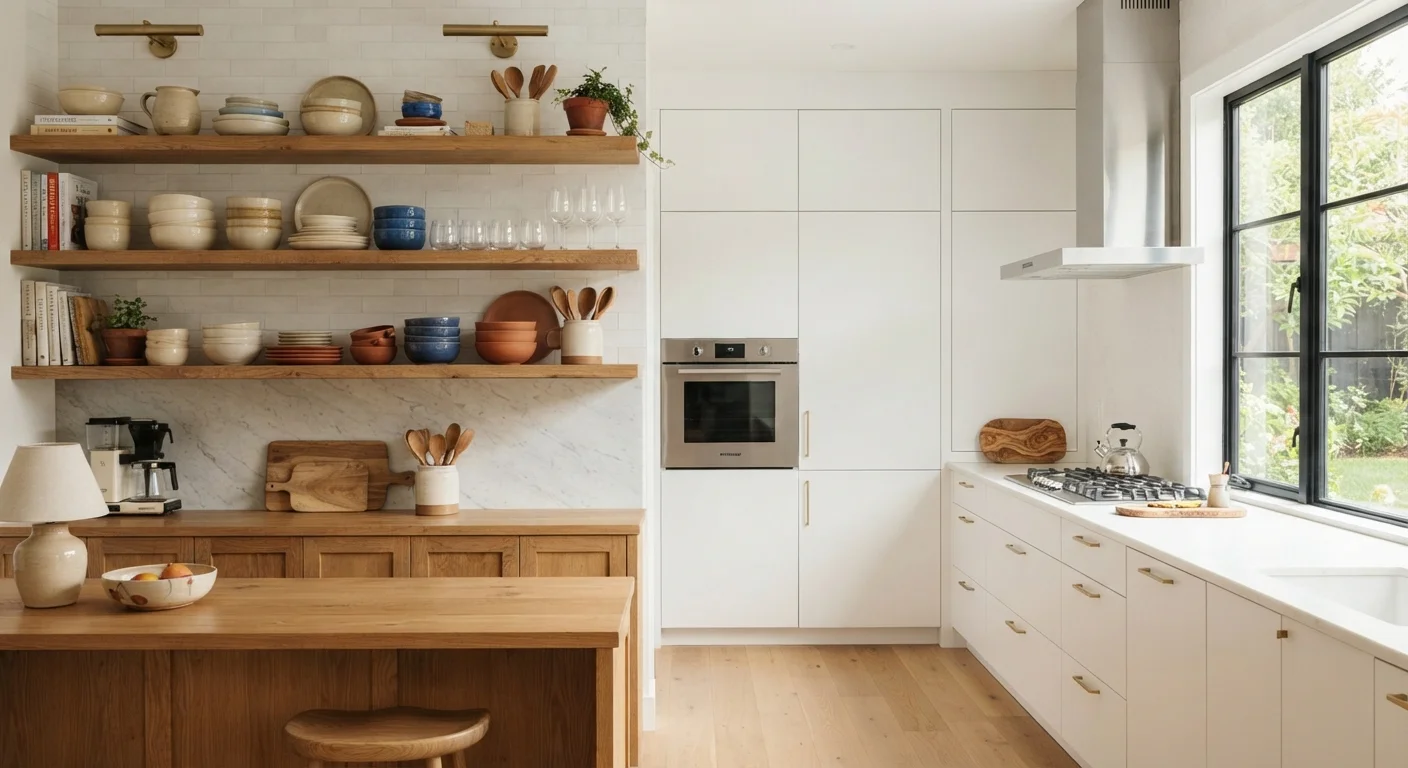
- Open shelving makes a kitchen feel larger and more accessible but requires consistent tidiness to look intentional.
- Closed cabinets conceal clutter effortlessly and protect items from grease and dust buildup.
- A hybrid approach - combining both styles - suits most kitchens and lifestyles.
- Your cleaning habits and how you use your kitchen daily matter more than aesthetics alone.
- Neither option is universally superior; the best choice depends on your household's specific needs.
Option A
Open Shelving
The airy, display-forward storage approach.
Best for: Homeowners who maintain tidy kitchens and want to showcase curated dishware or create a more open, spacious feel.
Option B
Closed Cabinets
The classic, hide-everything storage solution.
Best for: Households with varied clutter levels, busy families, or anyone who prefers a clean, uniform visual backdrop in the kitchen.
If you want a streamlined, low-maintenance kitchen
Closed Cabinets
Closed cabinets keep cooking residue, dust, and visual clutter hidden with minimal daily effort, making upkeep far more manageable.
If you want your kitchen to feel more open and bright
Open Shelving
Removing upper cabinet doors eliminates visual bulk and can make a compact kitchen feel significantly more spacious and inviting.
If you have a curated collection of dishware or cookware you love
Open Shelving
Open shelves turn attractive everyday items into décor, turning functional storage into a design statement at no extra cost.
If you have young children or a high-traffic, busy household
Closed Cabinets
Cabinets with doors reduce accidental breakage, keep curious hands away from fragile items, and simplify safety planning.
If you want flexibility without committing fully to one style
Open Shelving
Mixing open shelves for display items with closed lower cabinets for everyday clutter gives you the visual lift of open storage with the practicality of concealed space below.
What Each Storage Style Actually Involves
Open shelving replaces upper cabinet boxes - and their doors - with wall-mounted shelves or floating ledges. Everything stored on them is fully visible. Closed cabinets, by contrast, use hinged or sliding doors to conceal contents entirely. Both systems can use the same wall space and roughly the same volume of storage; the core difference is visibility and what that visibility demands from you as a homeowner.
It's worth noting that most kitchens already use a combination of both: base cabinets with doors below a countertop, plus some upper storage above. The debate typically centers on those upper storage zones, where the choice between open and closed most dramatically affects the kitchen's look and feel. For a broader look at how visual weight shapes a room, see how sightlines and visual weight affect a room's feel.
| Criterion | Open Shelving | Closed Cabinets |
|---|---|---|
| Visual effect | Airy, spacious feel | Clean, uniform backdrop |
| Dust & grease exposure | High - items exposed | Low - items protected |
| Cleaning frequency | More frequent wiping needed | Less frequent interior cleaning |
| Accessibility | Instant visual access | Requires opening doors |
| Clutter tolerance | Low - everything is visible | High - hides mismatched items |
| Installation complexity | Simpler - fewer components | More complex hardware and fitting |
| Style flexibility | Showcases curated collections | Adapts to any interior style |
The Real Advantages of Open Shelving
Open shelving's most cited benefit is the sense of visual breathing room it creates. Removing upper cabinet doors reduces the visual bulk on kitchen walls, which can make a smaller kitchen feel significantly less enclosed. Interior designers often use this technique in compact spaces - a principle explored more fully in our guide to small-space interior design strategies.
Accessibility is another genuine advantage. When items are always in sight, you're less likely to forget what you own or double-purchase ingredients. Open shelving also encourages you to keep only what you actively use - a natural form of editing that complements practices like a well-organized pantry system. The downside: grease, steam, and airborne cooking particles settle on everything. Open shelves require more frequent wiping down than their closed counterparts.
~30%
Homeowners choosing open shelving in new kitchen remodels
Houzz's annual kitchen trends reports have consistently shown open shelving appearing in roughly a quarter to a third of remodeled kitchens, reflecting sustained interest in the style.
1-2×/week
Recommended wipe-down frequency for open kitchen shelves
Kitchen design professionals generally advise wiping open shelves weekly to biweekly in actively used kitchens to prevent grease and dust accumulation.
Where Closed Cabinets Earn Their Place
Closed cabinets remain the dominant kitchen storage choice for practical reasons. They protect items from the humidity, grease, and odor that kitchens generate during everyday cooking. Dishes stored behind doors stay cleaner between uses and are less likely to chip from accidental contact. For households with inconsistent tidiness - which is most households - cabinets provide a reliable visual reset: close the door and the kitchen looks orderly regardless of what's inside.
Closed storage also offers more flexibility over time. You can adjust your organization system behind closed doors without it affecting your kitchen's overall appearance. This matters more than many people expect; as pointed out in common home organization myths, visible systems create ongoing pressure to maintain them perfectly - a burden that doesn't apply when storage is concealed.
Renting? Consider Reversible Options
If you're renting your home, permanently removing cabinet doors or installing wall-anchored shelving may violate your lease or require landlord approval. A practical alternative is to simply remove cabinet doors temporarily and store them, reinstalling before you move out. Always review your rental agreement and check with your landlord before making any structural changes, even minor ones.
How to Decide What Works for Your Kitchen
The most useful question isn't "which looks better?" but rather "how do I actually live in my kitchen?" Consider your cleaning cadence: open shelves typically need wiping every one to two weeks in an active kitchen. Think about what you'd display - mismatched or utilitarian items often look unintentional on open shelves, while cohesive sets of ceramics or glassware display beautifully. The same editing mindset that works for a wardrobe audit applies here: keep only what earns its visible space.
A practical hybrid approach works well for most kitchens: open shelving on one wall or in a specific zone (perhaps next to a window or in a breakfast nook), with closed cabinetry handling the bulk of everyday storage. This lets you enjoy the aesthetic benefits of open display without sacrificing the practicality of concealed storage where it matters most.