

Key Takeaways
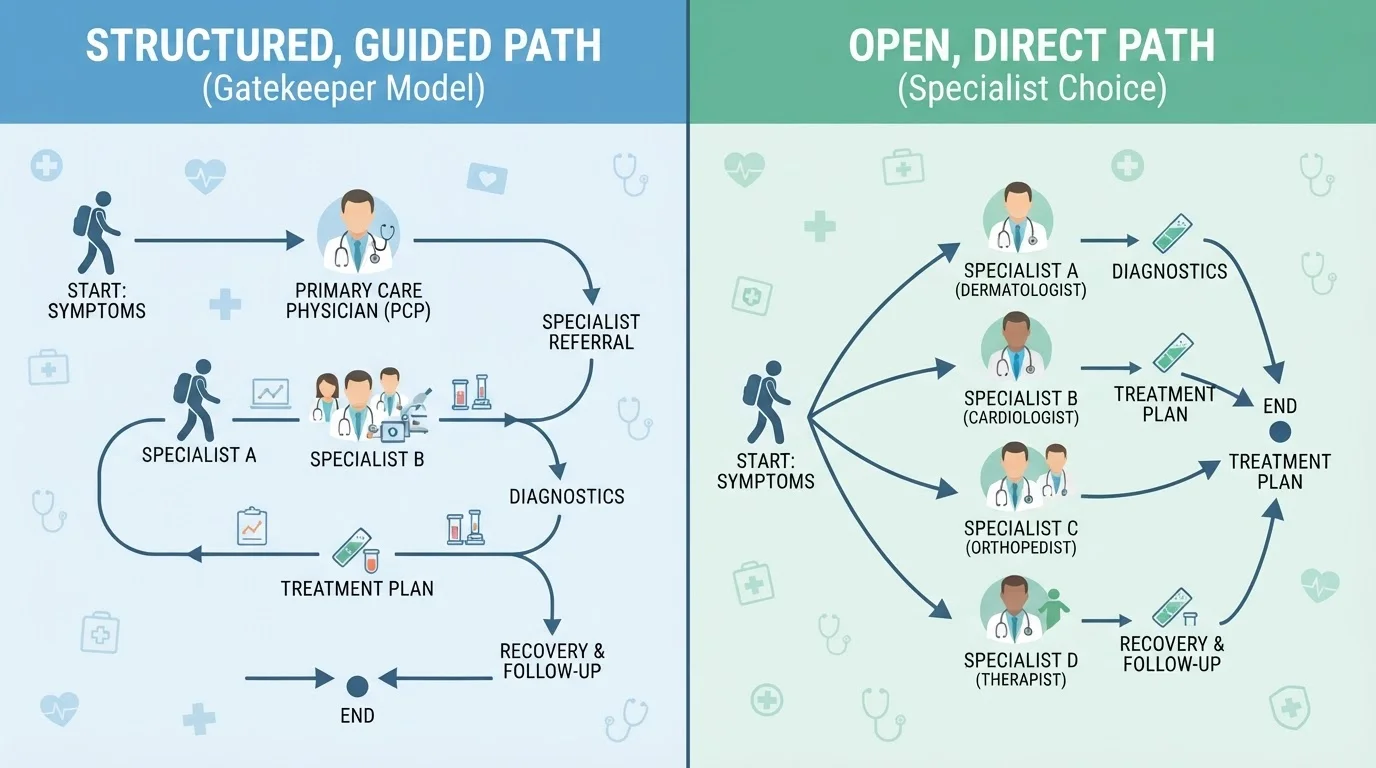
- HMOs require you to choose a primary care physician who coordinates all your care and provides specialist referrals.
- PPOs let you see any doctor without a referral, but out-of-network care costs significantly more.
- HMO premiums and deductibles are typically lower than comparable PPO plans.
- Going outside an HMO's network generally means paying the full cost yourself.
- Your actual costs depend on your specific plan's terms - always review the Summary of Benefits and Coverage.
Option A
HMO (Health Maintenance Organization)
The structured, coordinated-care plan.
Best for: People who want lower monthly premiums and don't mind working within a defined network and getting referrals for specialist visits.
Option B
PPO (Preferred Provider Organization)
The flexible, open-access plan.
Best for: People who want the freedom to see any doctor or specialist without a referral, including providers outside the plan's network.
If you want to keep monthly costs low and have a regular doctor you trust
HMO
HMOs typically carry lower premiums and predictable copays. If you're comfortable with network restrictions and referral requirements, an HMO can save money year-round.
If you manage a chronic condition and see multiple specialists regularly
PPO
A PPO lets you coordinate care across multiple specialists without needing referrals each time, which simplifies ongoing treatment management.
If you travel frequently or split time between two locations
PPO
PPO out-of-network coverage gives you a financial safety net when you need care away from your primary area, where your HMO network may not apply.
If you're generally healthy and mainly need preventive care
HMO
HMOs cover preventive services well and cost less per month when you aren't frequently accessing specialist care.
How Each Plan Controls Access to Care
The most fundamental difference between an HMO and a PPO comes down to one question: who decides which doctors you see?
With an HMO, you select a primary care physician (PCP) from the plan's network. That doctor becomes your entry point into the healthcare system - they handle routine care and, when you need a specialist, issue a referral. Without that referral, the HMO typically won't cover the specialist visit. This gatekeeping structure keeps care coordinated, but it does add a step.
A PPO removes that gate entirely. You can book an appointment with a specialist directly, no referral required. You're also not locked into a single network - PPOs have a preferred network of providers with better rates, but they also provide some coverage when you go outside it. That flexibility comes at a price, which we'll cover next.
For a broader look at how these plan types compare to EPOs and HDHPs, see our guide to choosing the right plan structure.
What the Network Difference Actually Costs You
Network rules aren't just administrative - they directly shape your out-of-pocket spending.
| Criterion | HMO | PPO |
|---|---|---|
| Requires primary care physician (PCP) | Yes, required | No, optional |
| Specialist referrals needed | Yes, from your PCP | No, self-refer anytime |
| Out-of-network coverage | Generally none (except emergencies) | Yes, at higher cost-sharing |
| Monthly premiums | Typically lower | Typically higher |
| Deductibles | Often lower | Often higher |
| Network size | Smaller, defined network | Larger, with in- and out-of-network tiers |
| Care coordination | PCP manages referrals | Self-directed by patient |
| Paperwork and claims | Minimal - network handles billing | More when using out-of-network providers |
HMO plans generally have lower monthly premiums because the insurer can negotiate tighter contracts with a limited group of providers. When nearly all care flows through that network, the insurer's costs are more predictable. You benefit from that predictability through lower premiums and often lower copays. The trade-off is that stepping outside the network - even by mistake - can leave you with the full bill.
PPOs carry higher premiums partly because they're underwriting broader access. When you use in-network providers, your cost-sharing is similar to an HMO. But if you see an out-of-network doctor, you'll typically face a separate, higher deductible and a higher coinsurance rate. Some PPO plans still cover 60-70% of out-of-network costs after you meet that deductible; others cover far less. The specifics are in your plan's Summary of Benefits and Coverage (SBC) - always read it.
47%
U.S. workers enrolled in PPO plans
According to KFF's 2023 Employer Health Benefits Survey, PPOs remain the most common plan type offered through employers.
13%
U.S. workers enrolled in HMO plans
The same KFF 2023 survey found HMO enrollment at 13% among covered workers, reflecting its smaller but stable share of the market.
$1,978
Average annual deductible difference
KFF data shows meaningful deductible variation across plan types; individual plan terms set actual amounts, which can differ substantially.
To understand how premiums, deductibles, and coinsurance work together before comparing plans, our breakdown of what you're actually paying for walks through each term clearly.
Referrals, Flexibility, and Day-to-Day Reality
On paper, the referral requirement sounds like a minor inconvenience. In practice, it affects how quickly you can access specialist care.
If you're on an HMO and develop a skin condition, you'll typically need to call your PCP, get an appointment, receive a referral, and then schedule with a dermatologist. That process can add days or weeks. For non-urgent issues, many people find this workable. For time-sensitive situations, the delay can be frustrating.
PPO members skip that step. They can call the dermatologist directly. But self-directing care also puts more responsibility on the patient to verify that the provider is in-network before the appointment - out-of-network costs can add up quickly if you assume coverage that isn't there.
Emergency Care Is Treated Differently
Both HMO and PPO plans are generally required to cover emergency care regardless of whether the provider is in-network. If you have an HMO and visit an emergency room outside your network due to a genuine emergency, you shouldn't be billed as if you went out-of-network for routine care. That said, what qualifies as an emergency - and how follow-up care is handled - can vary by plan. Always review your plan documents and follow up with your insurer after an ER visit.
One practical consideration: if you already have a trusted specialist or want access to a specific medical center, check whether that provider is in-network for whichever plan type you're evaluating. Network participation changes annually, so verify at enrollment time, not just when you first selected your plan. The open enrollment checklist covers exactly this step.
Choosing Between HMO and PPO: Key Questions to Ask
Neither plan type is objectively better. The right fit depends on your health needs, financial situation, and tolerance for administrative friction.
- How often do you use healthcare? Frequent specialist visits often justify PPO flexibility. Mostly preventive care? An HMO's lower costs may make more sense.
- Do your current doctors accept the plan? Check the network directory before enrolling - not all providers participate in every plan.
- Can you absorb higher out-of-pocket costs? PPOs offer flexibility but charge more for it, especially out-of-network. Make sure the premium difference doesn't exceed what you'd realistically save.
- Do you travel regularly? HMO networks are often geographically limited. A PPO's out-of-network benefit provides a backstop if you need care while away from home.
If you're weighing a high-deductible option alongside either plan type, how HDHPs and HSAs work together explains a third path worth considering.
When you're ready to compare specific plans side by side during enrollment, this guide to picking a health plan without leaving money on the table walks through how to evaluate the full cost picture.
This article provides general information about health insurance plan types and is not personalized insurance, financial, or medical advice. Coverage terms, costs, and network rules vary by plan and insurer. Always review your plan's Summary of Benefits and Coverage and consult a licensed insurance professional before making coverage decisions.