
Employer-Sponsored vs. Marketplace Coverage: Understanding the Real Differences

Key Takeaways
- Employer-sponsored plans are typically subsidized by your employer, often making them less expensive out of pocket than comparable individual plans.
- Marketplace plans offer income-based subsidies called premium tax credits, which can significantly lower costs for eligible enrollees.
- You generally can't use Marketplace subsidies if your employer offers coverage deemed affordable and adequate under federal standards.
- Both plan types must cover the same essential health benefits under the Affordable Care Act.
- Losing job-based coverage is a qualifying life event that opens a Special Enrollment Period on the Marketplace.
- Plan networks, drug formularies, and out-of-pocket limits vary - read the actual plan documents before enrolling.
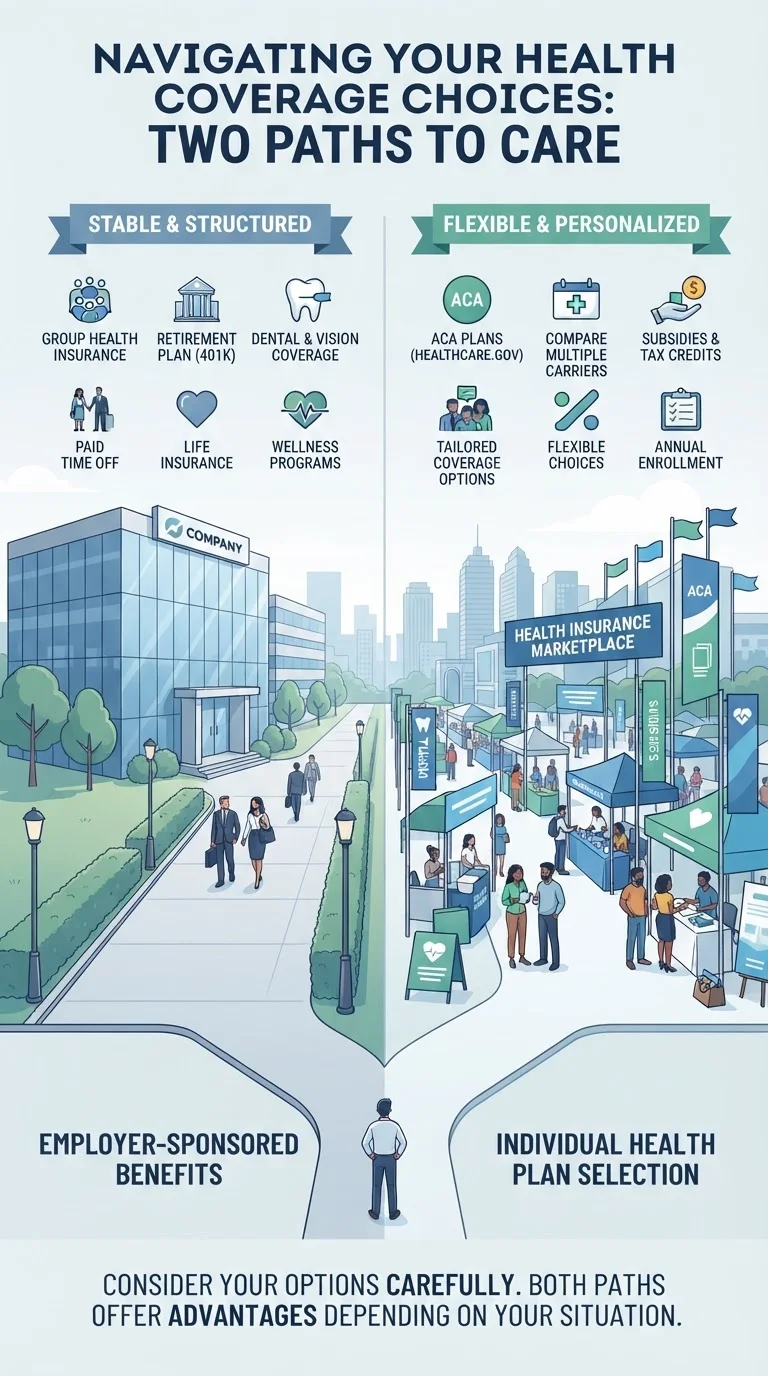
Option A
Employer-Sponsored Coverage
The workplace benefit - often subsidized and automatic.
Best for: Employees whose employer covers a meaningful share of the premium and whose family has access to group rates.
Option B
Marketplace Coverage
The individual marketplace - flexible, income-sensitive, and open to most Americans.
Best for: Self-employed individuals, part-time workers, and those who don't have access to affordable group coverage through a job.
If your employer covers at least half of your premium
Employer-Sponsored Coverage
Group coverage with significant employer contributions almost always delivers more value per dollar than individual Marketplace plans at the same benefit level.
If you're self-employed or your employer's plan is unaffordable
Marketplace Coverage
Premium tax credits tied to your income can substantially reduce costs, and you have a wider selection of plan options.
If your household income qualifies for expanded subsidies
Marketplace Coverage
Depending on income, some enrollees pay very low or even zero net premiums after tax credits are applied - an advantage employer plans can't match.
If provider choice and network breadth matter most
Employer-Sponsored Coverage
Large employer group plans often carry broad networks, though this varies by employer. Compare specific plan networks before assuming either is wider.
How Each Type of Coverage Works
Employer-sponsored health insurance is offered through your job. Your employer contracts with an insurer, negotiates group rates, and typically pays a portion of your monthly premium - sometimes a substantial one. You pay the remainder through pre-tax payroll deductions, which lowers your taxable income. Enrollment happens during your employer's open enrollment window or after a qualifying life event.
Marketplace coverage, available through HealthCare.gov or a state-based exchange, is purchased directly by individuals and families. Premiums are set by the insurer based on your age, location, tobacco use, and plan tier - not your health history, which the ACA prohibits as a rating factor. Enrollment is available during the annual Open Enrollment Period or during a Special Enrollment Period triggered by events like job loss, marriage, or the birth of a child. For a primer on how enrollment windows work, see our guide to Open Enrollment.
Both types of coverage must include the ACA's ten essential health benefits - things like preventive care, emergency services, prescription drugs, and mental health treatment. The underlying structure of the plans (HMO, PPO, and so on) is available in both markets. If you want to understand how those plan structures work, our breakdown of HMO, PPO, EPO, and HDHP plans covers the trade-offs in plain detail.
The Real Cost Differences
Cost is where these two options diverge most sharply - and where the comparison requires some math on your part.
| Criterion | Employer-Sponsored | Marketplace |
|---|---|---|
| Who pays the premium | Employer + employee split | Individual (credits may apply) |
| Pre-tax premium payments | Yes, via payroll deduction | No (after-tax, unless via HSA) |
| Income-based subsidies | Not available | Available if eligible |
| Plan choices | Employer's curated menu | All plans in your area |
| Enrollment trigger | Employer open enrollment | ACA Open Enrollment or SEP |
| Coverage if you leave the job | Ends (COBRA available, costly) | Unaffected by employment |
| Minimum coverage standards | ACA essential benefits required | ACA essential benefits required |
With employer coverage, your employer's contribution is the key variable. Federal law requires large employers to offer coverage, but doesn't set a minimum subsidy amount. In practice, employers often cover 70-80% of employee-only premiums, though family coverage contributions vary widely. The employee's share comes out pre-tax, reducing the real cost further.
Marketplace premiums are paid with after-tax dollars - unless you qualify for premium tax credits (also called advance premium tax credits, or APTCs). These credits are available to households earning between 100% and 400% of the federal poverty level, and under current law, some credit availability extends above that threshold. The credit is applied directly to your monthly premium, lowering what you actually pay. Cost-sharing reductions - which lower your deductibles and copays - are available at lower income levels for Silver-tier plans.
Here's the catch: if your employer offers you coverage that meets federal affordability and minimum value standards, you generally can't claim Marketplace subsidies, even if the employer plan doesn't feel affordable to you. The affordability test is based on the employee-only premium relative to household income. Understanding what you're actually paying for - premiums, deductibles, coinsurance - matters in both markets. Our guide to health insurance costs explains each piece clearly.
~83%
Workers offered employer coverage who enrolled
According to the Kaiser Family Foundation's annual Employer Health Benefits Survey, most workers offered coverage do take it - but offer rates and participation vary by firm size and industry.
$6,296
Average annual employee premium - employee-only coverage
The KFF 2023 Employer Health Benefits Survey reported the average annual employer-sponsored premium for single coverage was $8,435 total, with employees contributing roughly $1,401 on average.
~4 in 10
Marketplace enrollees paying $10 or less per month
CMS reported that for plan year 2024, a significant share of Marketplace enrollees received tax credits large enough to bring their net premium below $10 per month.
Flexibility, Choice, and Access
Employer plans are curated - your employer picks the insurer and the plan menu. You choose from what's offered, which may be one plan or several. This simplifies the decision but limits your control. If you change jobs, your coverage changes too. COBRA lets you stay on an employer plan temporarily after leaving a job, but you pay the full premium (including the employer's share) plus an administrative fee, which typically makes it expensive.
Marketplace plans give you more individual control. You choose your insurer, tier, and plan structure from every option available in your area. This flexibility is valuable if you have specific doctors, medications, or care needs that require a particular network or formulary. The trade-off is that you're doing more of the research yourself.
If you're weighing your options carefully, our guide to comparing health plans walks through how to evaluate networks, drug coverage, and total out-of-pocket exposure before you commit.
What Counts as 'Affordable' Employer Coverage?
Under ACA rules, an employer plan is considered affordable if the employee-only premium doesn't exceed a set percentage of the employee's household income (the threshold adjusts annually; check IRS guidance for the current figure). If the employer plan clears that bar, you're generally not eligible for Marketplace premium tax credits - even if covering your family through that plan would cost significantly more. This is sometimes called the 'family glitch,' and regulations have evolved to address it; verify your specific situation with a licensed navigator or benefits specialist.
This article is for general informational purposes only and is not personalized insurance, financial, or legal advice. Coverage terms, subsidy eligibility, and plan availability vary by employer, insurer, location, and individual circumstances. Read your actual plan documents and consult a licensed insurance professional or navigator before making coverage decisions.