
Wired Headphones vs. Wireless: What Sound Quality and Convenience Look Like at Each End

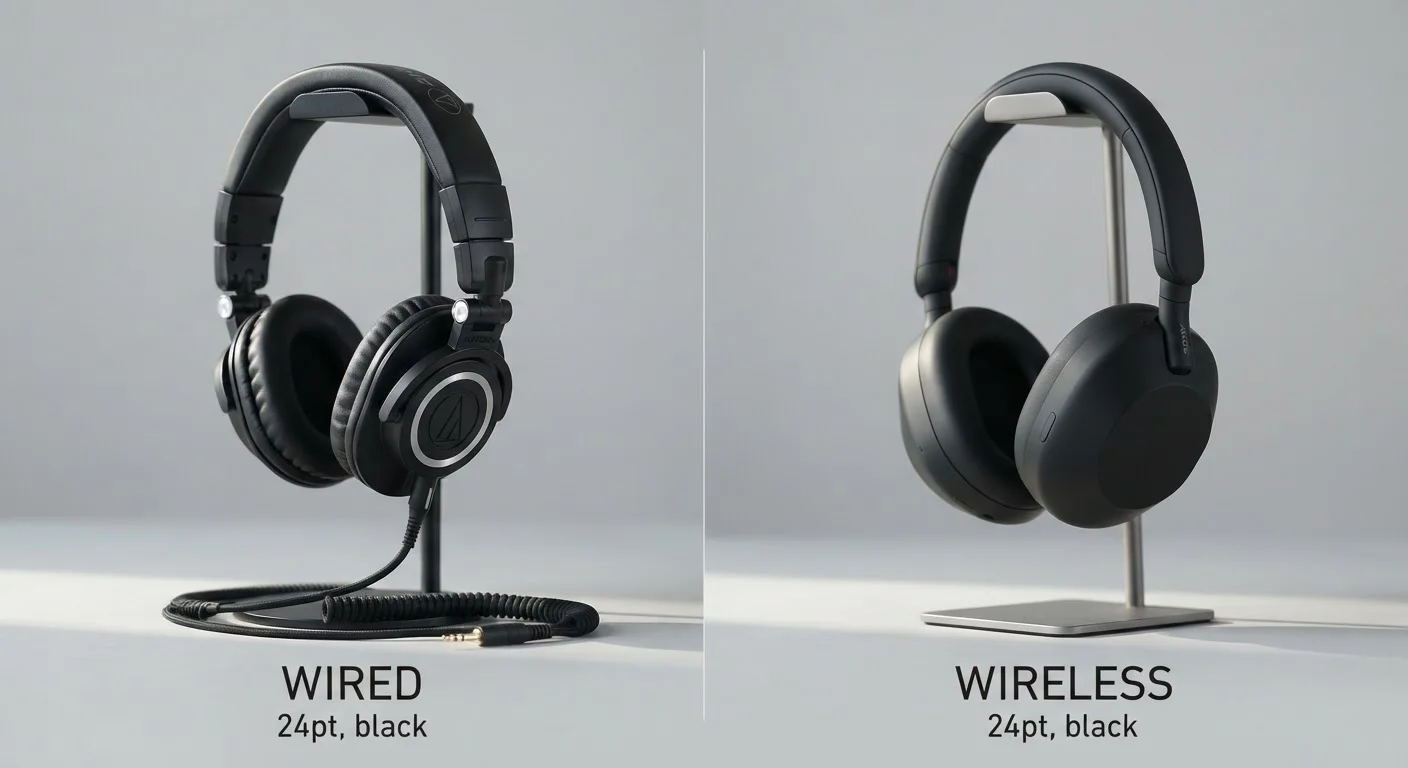
Key Takeaways
- Wired headphones deliver audio without compression or battery dependency, which matters for critical listening.
- Wireless headphones add convenience and freedom of movement at the cost of some audio fidelity and battery management.
- Bluetooth codec support - such as aptX, AAC, or LDAC - significantly affects wireless sound quality.
- Latency differences between wired and wireless are most noticeable during video playback and gaming.
- Neither design is universally superior; the right choice depends on your primary use case and listening environment.
Our Verdict
Wired headphones remain the stronger option for uncompromised audio fidelity, zero latency, and low-maintenance everyday listening. Wireless headphones win on convenience, portability, and freedom from cable management. For most consumers, the deciding factor comes down to whether you spend more time at a desk or on the move.
| Best for | Recommended |
|---|---|
| Critical listening, studio monitoring, or audiophile-grade playback | Wired headphones |
| Commuters, gym users, and those who prioritize cable-free movement | Wireless headphones |
| Gamers and video editors sensitive to audio-video sync | Wired headphones |
| Everyday general listeners who want active noise cancellation | Wireless headphones |
How Each Design Delivers Sound
Wired headphones transmit audio as an analog or digital electrical signal directly from the source device - no conversion steps between your music file and your ears beyond the built-in digital-to-analog converter (DAC) in your phone, computer, or dedicated audio interface. This direct path preserves the full resolution of the original file, making wired connections the default choice for studio work and audiophile listening.
Wireless headphones rely on Bluetooth transmission, which requires the audio to be encoded, sent over radio frequency, and decoded inside the headphones. This process introduces compression. The degree of quality loss depends heavily on the Bluetooth codec being used - the algorithm that compresses and decompresses audio data. SBC is the universal baseline codec and applies the most compression. Higher-quality codecs like aptX, AAC, and Sony's LDAC transmit significantly more audio data, narrowing the fidelity gap with wired connections. However, both the headphones and the source device must support the same codec for it to function. See our guide to Bluetooth versions and audio performance for a deeper breakdown of how codec support varies across Bluetooth generations.
| Wired Headphones | Wireless Headphones | |
|---|---|---|
| Audio Fidelity | Full resolution, no codec compression | Codec-dependent; LDAC/aptX reduce gap |
| Latency | Effectively zero | 20-300ms depending on codec and mode |
| Battery Required | No - draws power from source | Yes - typically 20-40 hours per charge |
| Freedom of Movement | Limited by cable length | Up to 30+ feet from paired device |
| Active Noise Cancellation | Rarely available (passive isolation only) | Commonly available on mid-to-high tier models |
| Compatibility | Adapter may be needed for modern devices | Works with any Bluetooth device |
| Long-Term Durability | Cable wear is main failure point | Battery degradation over 2-3 years |
Latency, Convenience, and Battery Considerations
Latency - the delay between audio output and what you hear - is effectively zero in wired connections. Wireless audio introduces a measurable delay, typically ranging from 20 to 300 milliseconds depending on the codec and hardware. For casual music listening, most people won't perceive this. For gaming or video editing, even moderate latency can cause distracting audio-video desync. Some wireless headphones offer a dedicated "low-latency mode" that reduces delay, though often at the cost of audio quality.
On the convenience side, wireless headphones eliminate cable tangling, allow movement up to 30 feet or more from a paired device, and frequently integrate active noise cancellation (ANC) - a feature that requires onboard processing not typically available in passive wired designs. However, wireless models require regular charging, and battery health degrades over time. A set of wireless headphones with a non-replaceable battery may deliver noticeably shorter listening sessions after two or three years of regular use. Wired headphones have no power requirement and remain operational as long as the cable and drivers are intact.
Check Codec Support Before You Buy Wireless
To get the best audio quality from a wireless pair, confirm that both your headphones and your source device support the same high-quality codec - such as aptX HD, AAC, or LDAC. If your phone only outputs SBC and your headphones advertise LDAC, you'll default to the lower-quality baseline. Most manufacturers publish supported codec lists in product specifications.
Cable durability is a legitimate concern with wired headphones - the connection point where the cable meets the headphone jack is a common failure spot. When evaluating wired models, look for reinforced, braided, or user-replaceable cables. For broader advice on keeping electronics in good condition longer, see our guide to long-term electronics care.
Compatibility, Cost, and Practical Trade-Offs
The removal of the 3.5mm headphone jack from many smartphones has shifted the wired landscape. Wired listeners now frequently use USB-C or Lightning adapters, or invest in a standalone DAC/amplifier - an additional device that can improve sound quality but adds cost and bulk. Wireless headphones pair directly with any Bluetooth-enabled device, which covers virtually all modern smartphones, laptops, and tablets.
From a cost perspective, both categories span a wide price range. The key difference is that wireless headphones include electronics, a battery, a charging system, and often ANC circuitry - components that add to the price relative to a wired model with equivalent speaker drivers. Buying refurbished wireless headphones is one way some consumers manage cost; our article on the trade-offs of buying refurbished electronics covers what to verify before purchasing pre-owned audio gear.
~220ms
Typical SBC Bluetooth latency
Standard SBC codec latency is generally reported in the 200-270ms range, perceptible during video and gaming use.
990 kbps
Maximum LDAC bitrate
Sony's LDAC codec transmits up to 990 kbps, compared to SBC's ceiling of roughly 328 kbps, substantially reducing compression artifacts.
Ultimately, neither format has a universal edge. Wired headphones reward listeners who value simplicity and signal purity. Wireless headphones serve those whose routines demand mobility and integration with a broader device ecosystem. Understanding where each design makes concessions helps you match the right tool to the way you actually listen.