

Key Takeaways
- Engaged, responsive interactions - not total hours together - most strongly influence child development outcomes.
- Even short windows of focused attention can be meaningful if they're consistent and distraction-free.
- Everyday routines like meals and bedtime stories naturally create high-quality connection moments.
- Parental stress and distraction can undermine time spent together, even when hours are plentiful.
- Both quantity and quality matter - but the research leans toward attentiveness as the more powerful factor.
Quality Time (Child Development)
Quality time refers to interactions between a parent or caregiver and a child that are focused, responsive, and emotionally engaged - not simply time spent in the same room. Research in child development suggests that the nature and attentiveness of shared interactions matters significantly for a child's emotional security, language development, and social skills. It's less about clocking hours together and more about the quality of connection within those moments.
Developmental psychologists often tie quality time to concepts like 'serve-and-return' interactions - back-and-forth exchanges where a child initiates and an adult responds - which are strongly linked to healthy brain development in early childhood.
The Quality vs. Quantity Debate
For decades, parents - especially those balancing demanding work schedules - have been told that quality time matters more than quantity. It's a reassuring idea, but the research behind it is more nuanced than the bumper-sticker version suggests.
Child development researchers have consistently found that the nature of interactions - how responsive, warm, and attentive a parent is - has a stronger association with positive outcomes than the raw number of hours spent together. Studies tracking language development, emotional regulation, and secure attachment in young children repeatedly point to the same underlying mechanism: children thrive when caregivers engage with them, not merely near them.
That said, some research - notably studies on adolescents - has found that sheer availability still plays a role. Teenagers who have more access to parents, even during low-key downtime, tend to show better behavioral outcomes. So the honest answer is that both dimensions matter, but attentiveness is generally the more powerful lever.
~19 min
Daily one-on-one parent-child time (average, US)
Estimates from the American Time Use Survey suggest parents spend roughly 19 minutes per day in focused, one-on-one engagement with their children on average.
6x
More words heard by children in richer verbal environments
Research by child language scientists has found dramatic gaps in the volume and variety of words children hear depending on caregiver interaction patterns, with long-term effects on vocabulary and literacy.
3 in 5
Parents who report feeling too busy to connect
Multiple surveys of American parents indicate a majority feel they don't spend enough quality time with their children, often citing work demands and screen distractions as key factors.
What 'Engaged' Actually Looks Like
One of the most well-supported frameworks in early childhood research is the concept of serve-and-return interaction - a term used by developmental scientists to describe the back-and-forth exchanges between a child and a caregiver. A baby babbles; a parent responds with a smile and mimics the sound. A toddler points at a dog; a caregiver names it, asks a question, and builds on the moment. These rapid, responsive exchanges are considered foundational to healthy brain architecture.
Quality time doesn't require elaborate planning. It shows up in:
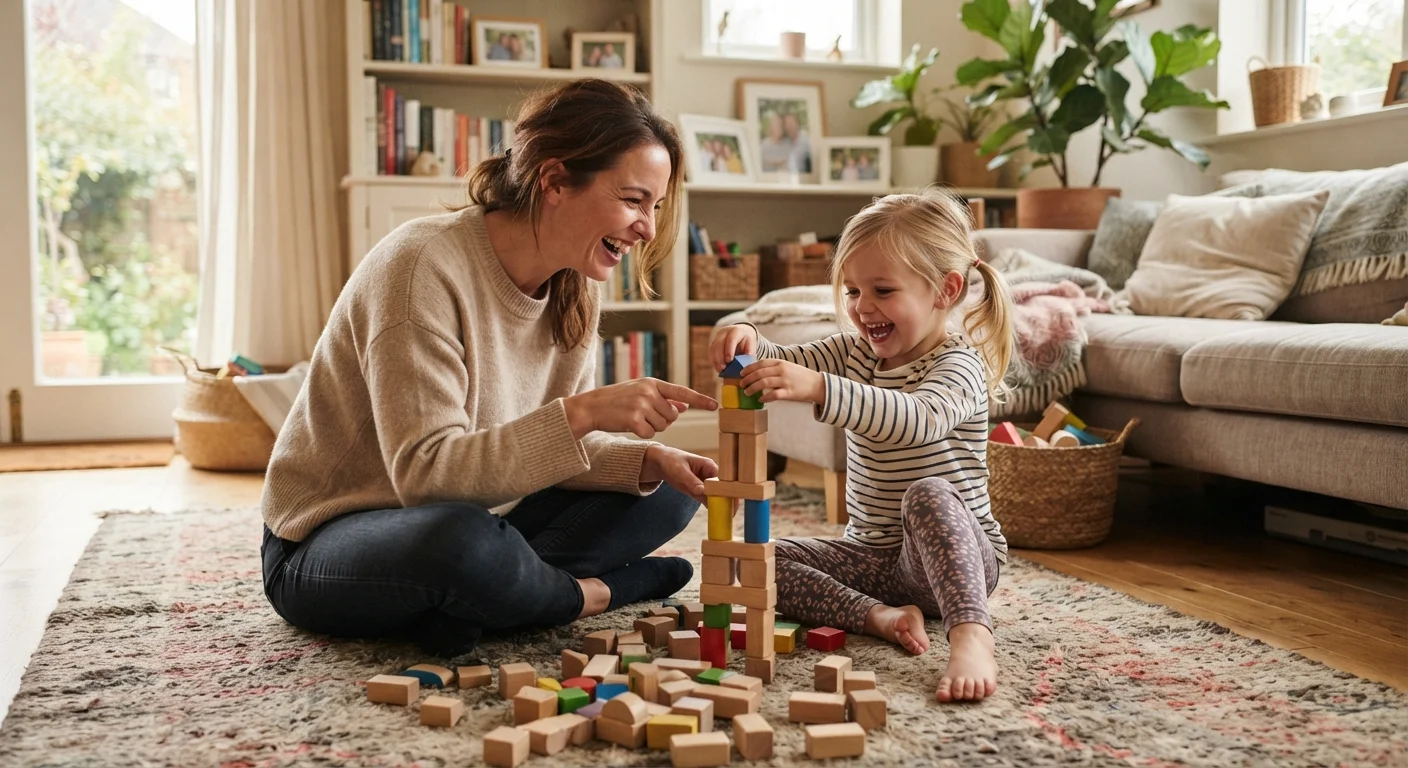
- Getting on the floor during play and following the child's lead
- Asking open-ended questions at dinner rather than scrolling a phone
- Reading aloud with real expression and pausing to discuss the story
- Listening without redirecting when a child shares something about their day
See our guide on family routines for practical ways to build these interactions into your existing daily structure.
Try the '10-Minute Full-Attention' Habit
Set aside just 10 minutes each day - phone face-down, TV off - to let your child lead the activity or conversation entirely. Child development professionals sometimes call this 'child-directed play,' and even this short window, done consistently, can strengthen your relationship and your child's sense of being truly seen. Consistency matters more than duration.
Everyday Moments That Count More Than You Think
Many parents picture quality time as a special outing or a dedicated activity block. But developmental research suggests that ordinary routines are often the richest environments for connection - precisely because they are repeated, predictable, and emotionally safe.
Family meals, for example, have been linked in multiple studies to better communication skills, stronger family cohesion, and improved emotional well-being in children. Bedtime routines - reading, talking, or simply being present without distraction - represent a nightly opportunity for focused, warm interaction.
The framing also matters at a family-systems level. How you structure your day as a family shapes when these pockets of connection naturally appear. Families with more intentional daily rhythms often find it easier to build consistent interaction into the flow of normal life rather than treating it as something extra to schedule.
What Gets in the Way - and How to Think About It
Parental stress, exhaustion, and distraction are among the biggest barriers to genuine engagement - and they're more common than any parenting article tends to acknowledge. A parent who is physically present but emotionally depleted is limited in their ability to respond warmly and attentively, regardless of how many hours they're in the same room.
This is worth naming honestly: taking care of your own mental well-being isn't separate from being a present parent - it's foundational to it. Research on parental sensitivity consistently shows that caregiver stress directly shapes the quality of adult-child interaction.
Device use is another common disruptor. Studies suggest that adult phone use during shared time can interrupt the responsiveness children need, reducing the relational value of the interaction. Our article on screen time rules at home explores this dynamic in more depth.
A Note on Parental Guilt
The 'quality vs. quantity' conversation can inadvertently add to parental guilt rather than relieve it. The research isn't meant to suggest that more time together is a problem - it simply highlights that presence and attentiveness are the key ingredients. If you're doing your best within real constraints, that already matters enormously to your child.
This article is for general informational and educational purposes only. For concerns about your child's development, please consult a qualified pediatric healthcare provider or child development professional.