

Key Takeaways
- A credit score is calculated from your credit report data, not your income or savings.
- Payment history is the single largest factor, accounting for roughly 35% of a FICO score.
- Multiple scoring models exist - lenders choose which one they use.
- Checking your own credit score does not hurt it.
- You are entitled to free credit reports from all three major bureaus annually.
- Small, consistent habits - like paying on time - have the biggest long-term impact on your score.
Credit Score
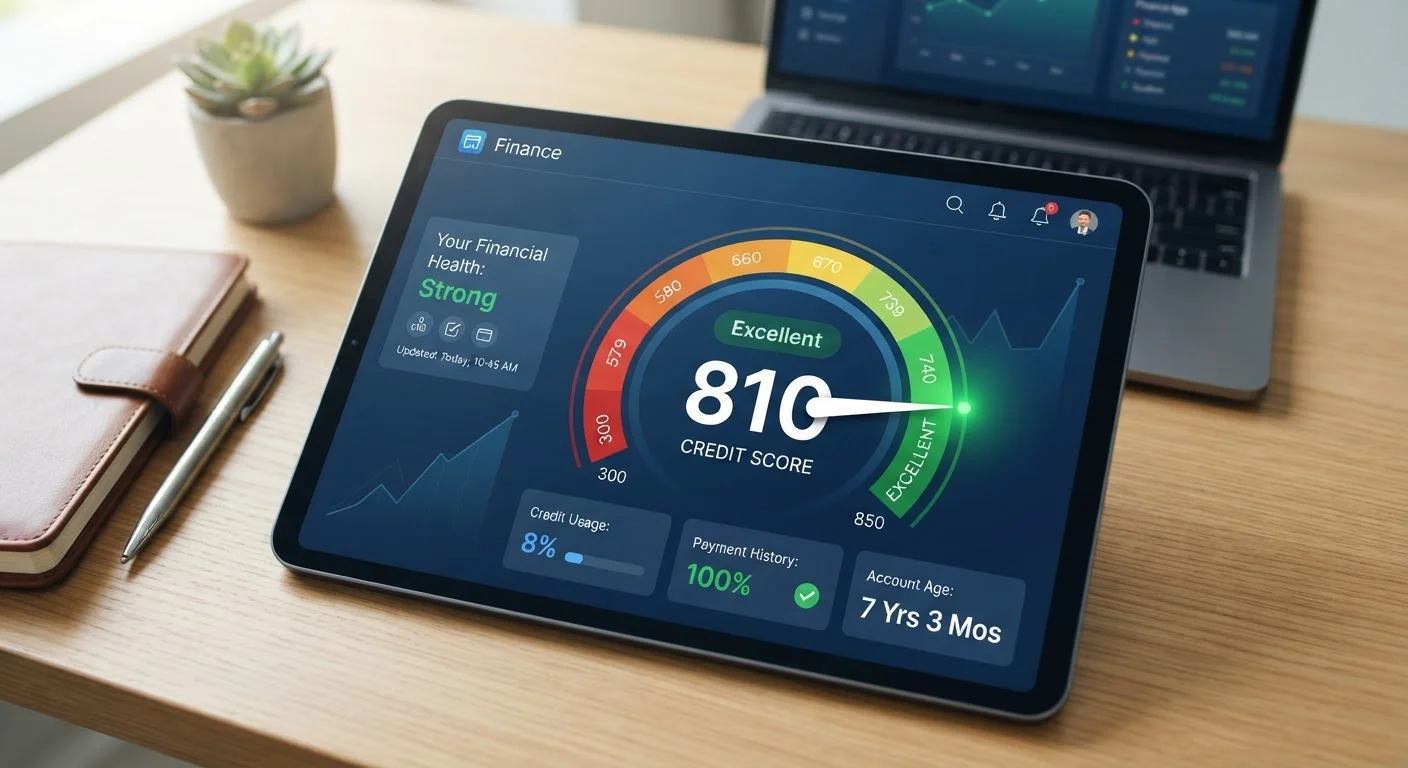
A credit score is a three-digit number - typically ranging from 300 to 850 - that summarizes how reliably you've managed borrowed money. Lenders use it to quickly assess the risk of lending to you. The higher your score, the more likely lenders are to view you as a responsible borrower.
Most lenders rely on FICO® Score models, though VantageScore is also widely used. Different scoring models may weight factors differently and produce slightly different numbers from the same underlying credit data.
What a Credit Score Actually Is
A credit score isn't a measure of your wealth, your income, or your worth as a person. It is a statistical prediction: specifically, how likely you are to repay debt on time over the next 24 months. Scoring models analyze the data in your credit report and compress it into a single number lenders can act on quickly.
The most commonly used score range is 300 to 850. That range was established by FICO - the Fair Isaac Corporation - whose models have been the industry standard since the late 1980s. VantageScore, a competing model developed jointly by the three major credit bureaus, uses the same 300-850 scale but weights some factors differently.
Neither score measures income, employment status, rent payments (unless reported), savings, or net worth. If you earn a high salary but have a history of missed payments, your score will reflect the missed payments - not the salary. For a plain-language breakdown of the terms behind credit reporting, see our debt and credit terms glossary.
35%
Weight of payment history in FICO scoring
According to FICO's published model breakdown, payment history is the single largest factor in a standard FICO score calculation.
200M+
Americans with a scoreable credit file
The Consumer Financial Protection Bureau has estimated that over 200 million Americans have credit files with the major bureaus, though millions more remain 'credit invisible.'
7 years
How long most negative items stay on a report
Under the Fair Credit Reporting Act, most negative items - such as late payments or collections - can remain on a credit report for up to seven years.
The Five Factors That Build Your Score
Under the FICO model, five categories of information drive your score. Understanding them clarifies why certain actions raise or lower your number:
- Payment history (≈35%): Whether you've paid bills on time. A single missed payment reported to a bureau can meaningfully lower a good score.
- Amounts owed / credit utilization (≈30%): How much of your available credit you're using. High balances relative to your credit limits signal risk. This factor is explored in depth in our article on credit utilization.
- Length of credit history (≈15%): The age of your oldest account, newest account, and the average age across all accounts. Longer histories generally help.
- Credit mix (≈10%): The variety of credit types you manage - revolving credit like cards, installment loans like auto or student loans.
- New credit (≈10%): Recent applications for new credit. Applying for several accounts in a short window can signal financial stress to a scoring model.
These percentages are approximate guidelines from FICO. Exact weightings shift based on the specific version of the scoring model and the individual's credit profile.
Start With Payment History - It Matters Most
If you can only focus on one habit, make it paying every bill on time. Even a single missed payment reported to a bureau can set back an otherwise strong score. Setting up automatic minimum payments is a straightforward way to protect this critical factor while you work on other areas of your credit profile.
Why You Have More Than One Score
Most Americans discover - sometimes with surprise - that they don't have a single credit score. They have dozens. There are multiple FICO model versions (FICO 8, FICO 9, FICO 10 are common), industry-specific versions designed for auto lenders or mortgage underwriters, and the VantageScore family. Each bureau - Equifax, Experian, and TransUnion - also maintains its own version of your credit file, so identical scoring models can produce different results from different bureaus.
The practical implication: the score you see on a free monitoring app may not be the exact score a mortgage lender pulls. What matters more than knowing your precise number is understanding which direction it's trending and whether the underlying credit report is accurate. You can request a free copy of your report from each of the three bureaus at AnnualCreditReport.com, the federally mandated source.
Many consumers harbor misconceptions about how scores work - things like believing that carrying a small balance on a card helps your score, or that closing old accounts is a good idea. These ideas are addressed directly in our piece on common credit score myths.
“Your credit score is essentially a snapshot of your creditworthiness at a single point in time. It's not a permanent grade - it changes as your credit behavior changes.”
— Consumer Financial Protection Bureau, U.S. federal consumer financial regulatory agency
How Lenders Actually Use Your Score
A credit score is a screening tool, not the final word. When you apply for a mortgage, car loan, credit card, or even certain rentals, a lender typically pulls one or more scores alongside your full credit report, income documentation, and other application data.
Scores influence two things primarily: whether you're approved at all, and what interest rate you're offered. A borrower with a higher score generally qualifies for lower interest rates, which translates to real savings over the life of a loan. A borrower with a lower score may face higher rates, stricter terms, or outright denial - though individual lender policies vary widely.
It's worth understanding what happens when lenders check your credit. Certain types of checks - known as hard inquiries - are recorded on your credit report and can cause a small, temporary dip in your score. Others, like checking your own score, have no effect at all. Our guide on hard inquiries vs. soft inquiries explains when each type applies.
This article is for general informational purposes only and does not constitute personalized financial or credit advice. For guidance specific to your situation, consider consulting a nonprofit credit counselor or a licensed financial professional.