

Key Takeaways
- Always start your budget from take-home pay, not your gross salary before deductions.
- Fixed expenses should be logged first so you know exactly what's non-negotiable each month.
- The 50/30/20 framework offers a flexible starting point for allocating spending and saving.
- Tracking actual spending for one month reveals where your plan and reality diverge.
- A budget is a living document - revisit and adjust it as your income or expenses change.
What you will need
Why Take-Home Pay Is the Only Number That Matters
Many budgeting mistakes start before a single dollar is allocated: people plan around their gross salary - the figure on a job offer letter - rather than the smaller amount actually deposited after taxes and deductions. The gap between the two can easily be 25-35% of your gross pay, depending on your tax bracket, benefits elections, and retirement contributions. Building a budget on gross income virtually guarantees overspending.
Take-home pay is the real constraint your spending must live within. Starting there means every category you fill in is grounded in money you genuinely have. If you've never built a budget before and want a broader foundation, our beginner's budget guide walks through every foundational concept alongside these steps.
What you will need
How to Build Your Budget Step by Step
The steps below walk you through the full process - from confirming your income to adjusting after your first real month of tracking. Gather the tools listed below before you begin so you're not stopping mid-process to find documents.
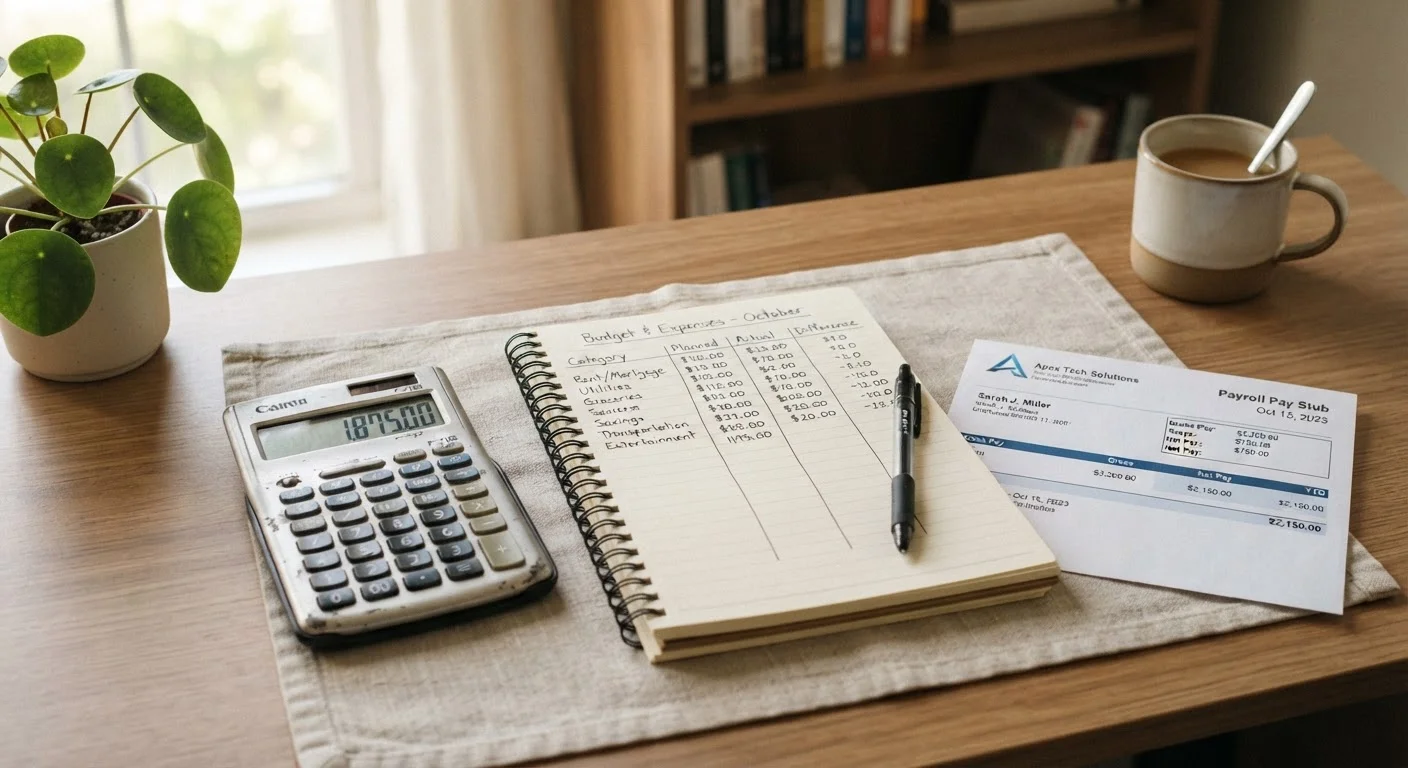
Pay stub or bank deposit records
Confirms your actual monthly take-home pay after taxes and deductions.
Bank and credit card statements
Reveals your real spending patterns across variable categories like groceries and dining.
Spreadsheet or budgeting app
Organizes income, expense categories, and monthly targets in one place.
Calculator
Helps you quickly total expenses and check that spending stays within income.
Determine your true monthly take-home pay
Your take-home pay - also called net pay - is what lands in your bank account after federal and state income taxes, Social Security, Medicare, and any pre-tax deductions like health insurance or a 401(k) contribution are removed. This is the only number that matters for building a workable budget.
If you're paid biweekly, multiply one paycheck by 26, then divide by 12 to get your monthly figure. If your income varies, see our guide on budgeting on an irregular income for alternative approaches.
List every fixed expense
Fixed expenses are bills that stay the same (or nearly the same) month to month. List them all: rent or mortgage, car payment, student loans, minimum credit card payments, insurance premiums, and any recurring subscriptions. Write down the exact monthly amount and due date for each.
Total your fixed expenses and subtract them from your take-home pay. The result is your discretionary income - what remains for variable spending and saving.
Estimate your variable monthly expenses
Variable expenses shift from month to month: groceries, gas, utilities, dining out, clothing, and entertainment. Pull two to three months of bank and credit card statements and calculate a realistic average for each category. Rounding up slightly builds in a small buffer.
Common categories to track: groceries, utilities, transportation (fuel, transit, parking), personal care, dining and takeout, household supplies, and medical co-pays.
Apply a spending framework
A framework helps you allocate what's left after fixed bills. One widely referenced guideline is the 50/30/20 rule: roughly 50% of take-home pay toward needs (housing, food, utilities, transportation), 30% toward wants (dining, entertainment, hobbies), and 20% toward saving and debt repayment beyond minimums.
This is a starting point, not a rigid rule. High-cost-of-living areas may require a larger needs percentage. Adjust the ratios to fit your actual situation. If you're newer to budgeting, a ground-up beginner's guide can help you build the foundations alongside this framework.
Assign a savings target
Before closing your budget, explicitly name what you're saving for and how much you plan to set aside each month. Even a small, consistent amount directed toward an emergency fund creates financial resilience over time. Treating savings as a non-negotiable line item - not an afterthought - is a habit that compounds in value.
For strategies on building emergency funds and working toward longer-term goals, explore our saving and goals hub.
Track spending for one full month and adjust
A budget written on paper is only a plan. Spend one full month logging every purchase against your categories - most banking apps can export transactions by category. At month's end, compare actual spending to your targets. Gaps between plan and reality are data, not failures; they tell you where to tighten or where your estimates were off.
Revise your budget for the following month based on what you learned. Many households discover overlooked expenses at this stage - for a deeper look at what families commonly miss, see running a household budget.
Make Your Budget a Monthly Ritual
Set aside 15-20 minutes at the start of each month to review last month's actuals and adjust your upcoming plan. Treating budgeting as a recurring appointment - not a one-time setup - is what turns it from a document into a genuine financial habit.
This article provides general financial information for educational purposes only and is not personalized financial advice. Consider speaking with a qualified financial professional about decisions specific to your circumstances.
Common Mistakes to Avoid
Even a well-structured budget can quietly fail if a few key errors go uncorrected:
- Underestimating irregular expenses. Car repairs, medical bills, and annual fees derail budgets built only around monthly predictables. A dedicated buffer category - sometimes called a "sinking fund" - smooths these out.
- Treating a balanced budget as finished. Life changes: a raise, a new bill, a move. A budget should be reviewed at least every few months and updated when circumstances shift.
- Confusing net worth tracking with budgeting. Watching account balances grow is not the same as managing monthly cash flow. Both matter, but they answer different questions.
Persistent myths about who budgets are "for" can also hold people back. Common budgeting myths - like the idea that you need a high income to save - are worth examining before they shape your habits. And if your income doesn't arrive in a predictable amount each month, the strategies in our guide on budgeting on irregular income apply directly to your situation.
Don't Let Perfect Be the Enemy of Started
Many people delay building a budget because they want a flawless system from day one. An imperfect budget you actually use is far more valuable than an ideal one you never finish. Start with your best estimates and refine as real data comes in.