

Key Takeaways
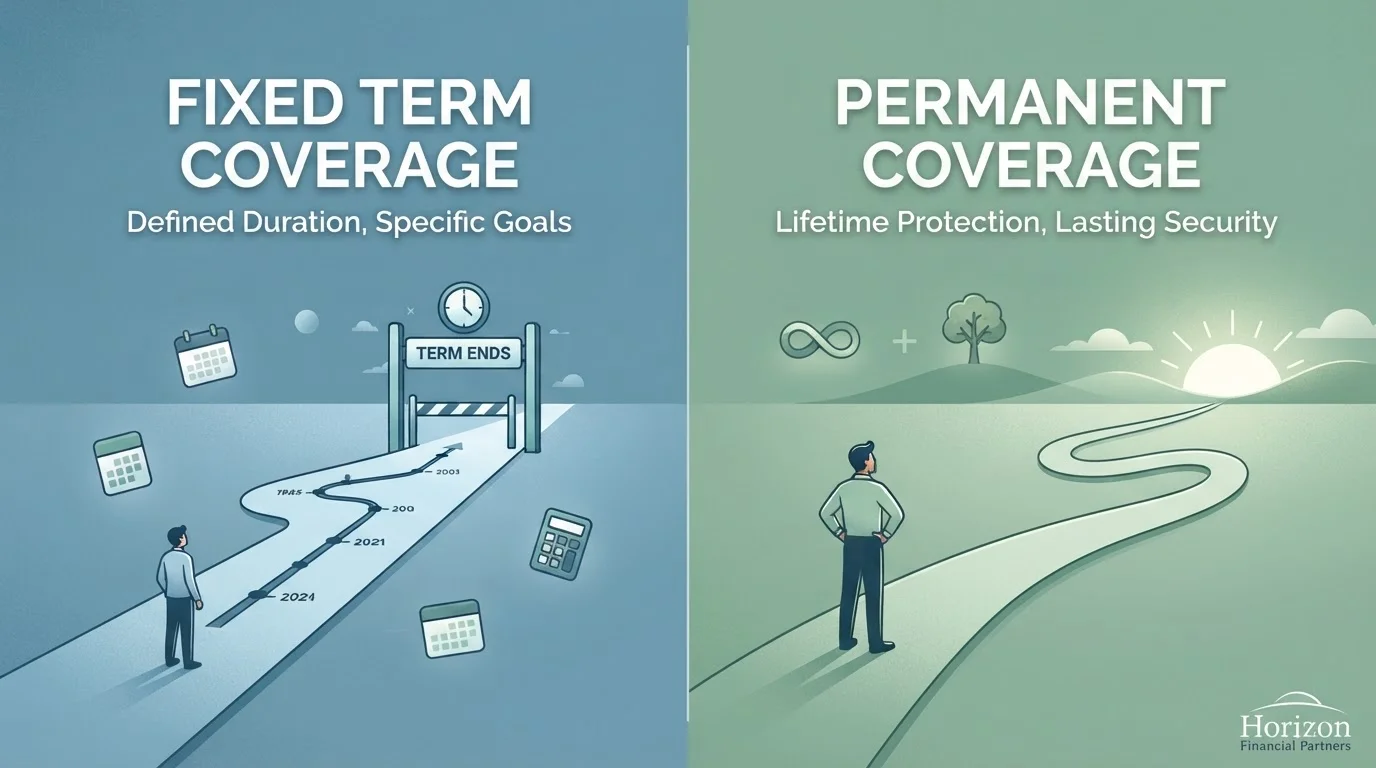
- Term life covers a set period (often 10-30 years); whole life covers you for your entire life.
- Term premiums are generally much lower than whole life premiums for the same death benefit amount.
- Whole life builds cash value over time that you can borrow against; term does not.
- Neither type is universally better - the right fit depends on your goals, budget, and timeline.
- Most insurers allow term policyholders to convert to permanent coverage, subject to policy terms.
Option A
Term Life Insurance
Straightforward, time-limited protection at lower cost.
Best for: People who need a large death benefit during specific years - raising children, paying a mortgage, or replacing income - without long-term premium commitments.
Option B
Whole Life Insurance
Permanent coverage combined with a savings component.
Best for: People who want lifelong coverage, a guaranteed death benefit regardless of age, and a cash-value component that grows over time.
If you need maximum coverage for minimum monthly cost
Term Life Insurance
Term policies deliver a large death benefit at a fraction of the cost of whole life, making them practical when budget and a defined protection window are the main concerns.
If you want coverage that never expires regardless of age
Whole Life Insurance
Whole life guarantees a death benefit for as long as premiums are paid, so your beneficiaries receive a payout whether you pass away at 55 or 95.
If you're covering a specific debt or income-replacement window
Term Life Insurance
Matching a 20-year term to a 20-year mortgage or child-rearing period means you're paying only for the protection you actually need during that time.
If long-term estate planning or wealth transfer is a priority
Whole Life Insurance
A guaranteed death benefit combined with cash value growth can serve specific estate planning goals, though you should consult a qualified financial adviser for your situation.
If you're early in your career and primarily want income replacement
Term Life Insurance
Younger buyers can lock in low term premiums now while keeping the flexibility to reassess their insurance strategy as income and assets grow.
How Each Policy Is Structured
The most fundamental difference between these two types of coverage is time. Term life insurance provides a death benefit for a defined period - commonly 10, 20, or 30 years. If the insured person dies within that window, the policy pays out. If the term ends and the policyholder is still living, coverage simply expires (unless renewed or converted).
Whole life insurance, by contrast, is permanent. It does not expire after a set number of years. As long as premiums are paid, the policy stays in force for the policyholder's lifetime, and the death benefit is guaranteed to pay out eventually.
Whole life also includes a cash value component - a savings element that grows on a tax-deferred basis over the life of the policy. Term policies have no cash value; the premium buys pure death benefit protection and nothing else.
For a broader look at how these products fit into the wider landscape of life coverage, see Life Insurance Explained: Term, Whole, and Universal Coverage in Plain English.
| Criterion | Term Life | Whole Life |
|---|---|---|
| Coverage duration | Fixed term (e.g., 10-30 years) | Lifetime (permanent) |
| Death benefit | Paid if death occurs within term | Guaranteed payout eventually |
| Typical premium cost | Lower for same benefit amount | Significantly higher |
| Cash value | None | Builds over time (tax-deferred) |
| Premium flexibility | Fixed for the term period | Fixed and level for life |
| Complexity | Simple structure | More complex (cash value, loans) |
| Conversion option | Often available (policy-dependent) | Not applicable |
Cost Differences and What Drives Them
Premium cost is where the gap between these two products is most visible. Term life premiums are typically far lower than whole life premiums for the same death benefit amount. The reason is straightforward: an insurer is taking on a time-limited risk with term coverage. With whole life, a payout is mathematically certain at some point, so the insurer prices that certainty into every premium.
~5-15×
Whole life premium vs. comparable term
Industry sources commonly note whole life premiums run several times higher than term premiums for the same death benefit, though exact ratios vary by age and underwriting.
20 years
Most common term length purchased
According to LIMRA, a US insurance industry research organization, 20-year term policies are among the most widely purchased term lengths in the United States.
~54%
US adults with some life insurance coverage
LIMRA's research consistently shows roughly half of American adults carry some form of life insurance, though coverage gaps remain widespread.
Several factors shape the premium you'll pay on either type - age at application, health history, smoking status, and the coverage amount all play significant roles. What Actually Affects Your Life Insurance Premium covers this in detail if you want to understand how underwriters evaluate risk.
Whole life premiums are also fixed and level - they don't increase as you age, which is a feature some policyholders value. Term premiums are fixed for the term period, but if you renew or buy a new policy later in life, your age and current health will be factored in at that time.
Cash Value: What It Is and What It Isn't
The cash value in a whole life policy grows slowly in the early years - a significant portion of each premium goes toward insurer costs and profit margins before meaningful accumulation begins. Over many years, that value can become substantial, and policyholders can borrow against it or, in some cases, surrender the policy for its cash value.
It's worth being clear-eyed here: cash value is not a separate investment account, and the growth rate is generally modest compared to market-based alternatives. It functions more like a slow-building, insurer-held reserve tied to your coverage - not a primary wealth-building vehicle. Borrowing against cash value also reduces the death benefit if the loan isn't repaid.
Term-to-Permanent Conversion
Many term life policies include a conversion provision that lets you switch to a permanent policy - often without a new medical exam - before a specified deadline. This can be valuable if your health changes and you later decide you want lifelong coverage. Check your specific policy's terms, as conversion windows and available permanent products vary by insurer.
Term policies carry none of this complexity. The trade-off is that there's no accumulation and no residual value if you outlive the term - but for many people, that simplicity is exactly what they want from insurance.
Which Situations Favor Each Type
Neither term nor whole life is a universally superior product. The right choice depends on what you actually need coverage to do.
Term tends to make sense when:
- You have dependents who rely on your income and need protection during specific years
- You're carrying a mortgage or other large debt with a defined payoff timeline
- Your budget requires keeping premiums low
- You expect your need for coverage to decrease over time as you build assets
Whole life tends to make sense when:
- You want guaranteed coverage that won't expire regardless of how long you live
- Leaving a guaranteed inheritance or covering final expenses is a priority
- You have a long-term estate planning goal that a qualified adviser has identified as suited to permanent coverage
Before finalizing any policy, reading the actual document carefully is essential. Reading a Life Insurance Policy: The Sections That Matter Most can help you navigate the key clauses without getting lost. And when you're ready to move forward, Applying for Life Insurance: A Walkthrough of the Process covers what to expect step by step.
This article is for general informational purposes only and does not constitute personalized financial, insurance, or legal advice. Coverage terms, costs, and eligibility vary by insurer and individual circumstances. Consult a licensed insurance agent or qualified financial adviser before making coverage decisions.