

Key Takeaways
- Hardwood flooring can be sanded and refinished multiple times, extending its lifespan well beyond 50 years.
- Luxury vinyl plank resists moisture and scratches far better than hardwood, making it ideal for kitchens and bathrooms.
- Hardwood typically costs more upfront and requires more careful maintenance than LVP.
- LVP has improved dramatically in appearance, often convincingly mimicking real wood grain and texture.
- Neither option is universally superior - the right choice depends on your household's lifestyle, budget, and room conditions.
Option A
Hardwood Flooring
The timeless, natural choice with lasting prestige.
Best for: Homeowners seeking classic aesthetic value, long-term investment potential, and the ability to sand and refinish over decades.
Option B
Luxury Vinyl Plank (LVP) Flooring
The resilient, moisture-resistant modern alternative.
Best for: Households with pets, children, or moisture-prone rooms that need durable, low-maintenance flooring at a more accessible price point.
If you want flooring that adds long-term property value
Hardwood Flooring
Real hardwood is widely regarded by real estate professionals as a premium home feature that appeals to buyers. Its refinishable surface means it can look new again decades later.
If you have pets, young children, or high-traffic areas
Luxury Vinyl Plank (LVP) Flooring
LVP's wear layer resists scratches, dents, and spills more effectively than hardwood, making it a practical choice for busy, active households.
If you're flooring a bathroom, laundry room, or basement
Luxury Vinyl Plank (LVP) Flooring
Hardwood and moisture are a poor combination. LVP is 100% waterproof in most constructions, making it safe for areas prone to humidity or occasional water exposure.
If you're renovating a historic or traditionally styled home
Hardwood Flooring
Authentic hardwood preserves the architectural integrity of period homes and can be matched or restored to complement original design details.
If you're working with a tighter renovation budget
Luxury Vinyl Plank (LVP) Flooring
LVP generally costs less per square foot for materials and installation, and its DIY-friendly click-lock systems can further reduce labor costs.
Durability and Everyday Wear
When it comes to standing up to daily life, hardwood and luxury vinyl plank take very different approaches to durability.
Hardwood is genuinely tough, but it's vulnerable to moisture, deep scratches, and denting - particularly softer species like pine. Harder species such as hickory or white oak resist surface damage better. One major advantage: when hardwood shows significant wear, it can typically be sanded down and refinished, effectively resetting its appearance. Most solid hardwood floors can be refinished three to five times over their lifespan.
Luxury vinyl plank features a protective wear layer - measured in mils (thousandths of an inch) - that resists scratches, scuffs, and staining. Residential-grade LVP typically carries a 12-20 mil wear layer, while commercial-grade products go higher. However, unlike hardwood, heavily worn or damaged LVP cannot be refinished; individual planks must be replaced.
| Criterion | Hardwood Flooring | Luxury Vinyl Plank (LVP) |
|---|---|---|
| Typical lifespan | 50+ years (refinishable) | 15-25 years (not refinishable) |
| Moisture resistance | Low - avoid wet areas | High - fully waterproof options |
| Scratch resistance | Moderate (species-dependent) | High (wear layer protection) |
| Material cost | Higher | Generally lower |
| DIY installation | Difficult - often professional | Moderate - click-lock systems |
| Refinishable | Yes - multiple times | No - replace planks only |
| Resale appeal | Strong - premium perception | Moderate - improving |
| Underfoot feel | Solid, warm, natural | Slightly softer, can feel hollow |
Cost and Installation
Budget is often the deciding factor between these two flooring types, and the differences are significant at every stage.
Hardwood flooring materials generally range from moderately priced domestic species to premium imported or exotic options. Installation adds considerable cost because hardwood typically requires professional nail-down or glue-down methods and sometimes subfloor preparation. Acclimation time - allowing the wood to adjust to your home's humidity before installation - also extends the project timeline.
LVP is typically less expensive per square foot for materials, and many products feature a floating click-lock system that experienced DIYers can install themselves over most existing floors, reducing or eliminating labor costs. There's no acclimation period required for most LVP products.
$3-$10+
Hardwood material cost per square foot
Costs vary widely by species, grade, and finish; installation labor typically adds $3-$8 per square foot depending on region.
$2-$7
LVP material cost per square foot
Mid-range residential LVP with a quality wear layer generally falls in the $3-$5 per square foot range, with installation often lower than hardwood.
50+ years
Potential hardwood floor lifespan
Properly maintained and periodically refinished solid hardwood floors in historic homes have been documented lasting well over a century.
Keep in mind that installation costs vary widely by region, floor condition, and room complexity. Always get multiple quotes from licensed flooring installers before committing to either option.
Moisture Resistance and Room Suitability
This is where LVP has a clear structural advantage. Most luxury vinyl plank products are fully waterproof - the core doesn't swell, warp, or buckle when exposed to moisture. This makes LVP a practical option for kitchens, bathrooms, laundry rooms, and below-grade spaces like basements.
Hardwood and moisture are fundamentally at odds. Solid hardwood expands and contracts with changes in humidity, and prolonged exposure to standing water can cause warping, cupping, or staining. Engineered hardwood - which features a real wood veneer over a plywood core - handles humidity somewhat better than solid hardwood but is still not recommended for consistently wet areas.
Engineered Hardwood: A Middle Ground
Engineered hardwood consists of a real wood veneer bonded to a multi-layer plywood core. It handles humidity fluctuations better than solid hardwood and can sometimes be installed in moderate-moisture areas where solid hardwood is unsuitable. However, it can typically only be refinished once or twice due to the thin veneer layer. It occupies a useful middle position between solid hardwood and LVP for homeowners who want real wood character with slightly improved dimensional stability.
If your home has radiant floor heating, check manufacturer specifications carefully for both flooring types. Some hardwood species and certain LVP products are compatible with in-floor heating systems, but not all.
Aesthetics, Feel, and Long-Term Value
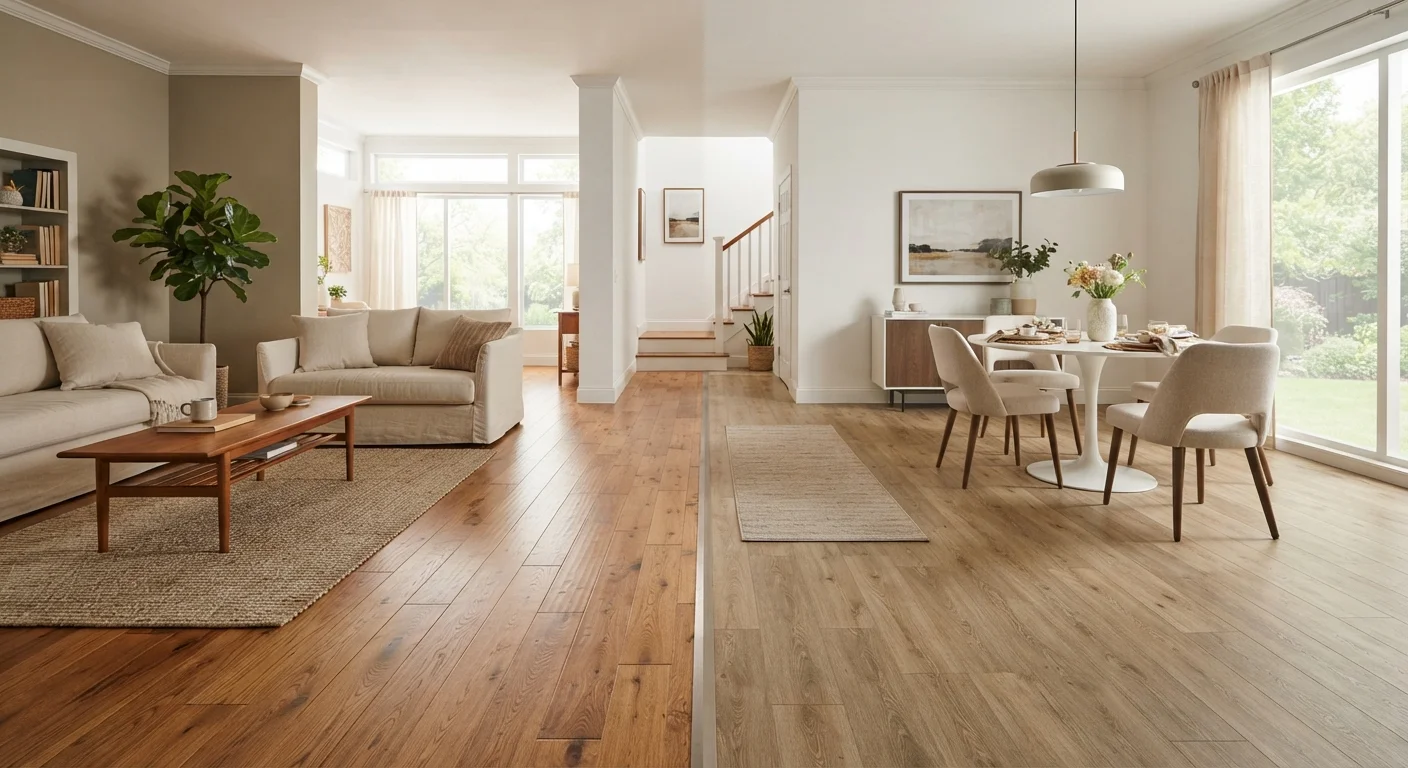
This is where hardwood maintains a meaningful edge for many homeowners. Real wood carries natural variation, warmth underfoot, and an authenticity that even the best LVP products replicate rather than replicate exactly. Over time, hardwood develops a patina that many people find appealing. If you're drawn to the genuine character of natural materials, that's difficult to substitute.
LVP has improved enormously in appearance over the past decade. High-quality products now feature embossed textures, realistic wood-grain printing, and varied plank lengths that convincingly mimic natural wood. From a standing distance, distinguishing quality LVP from hardwood can be genuinely difficult. However, LVP tends to feel slightly hollow underfoot and does not carry the same perceived prestige in the real estate market.
From a long-term value standpoint, hardwood flooring is widely associated with higher home resale appeal, though individual market conditions vary. LVP's value proposition lies in its durability and lower replacement cost over time.