
Mindfulness vs. Meditation: Two Related Practices That Work Very Differently

Key Takeaways
- Mindfulness is a quality of attention; meditation is a formal practice used to train that attention.
- You can be mindful without meditating, but meditation often cultivates mindfulness over time.
- Research supports both approaches for reducing stress, though evidence strength varies by context.
- Neither replaces professional mental health care when that level of support is needed.
- The best approach is the one you'll actually use consistently in your own life.
Option A
Mindfulness
Present-moment awareness woven into everyday life.
Best for: People who want to reduce reactivity and stress without setting aside dedicated practice time.
Option B
Meditation
A structured, intentional mental training practice.
Best for: People seeking deeper focus, emotional regulation, or a consistent formal practice with measurable habits.
If you have little time and want stress relief woven into your day
Mindfulness
Mindfulness requires no scheduled sessions - it can be practiced during commutes, meals, or conversations, making consistency more achievable for busy schedules.
If you want a structured habit with clear technique to follow
Meditation
Formal meditation sessions provide a defined framework - breathing techniques, body scans, or guided imagery - that some people find easier to track and build on.
If you're managing significant anxiety or depression
Consult a professional first
Both practices may complement professional care, but neither substitutes for therapy or psychiatric support. A qualified provider can help you decide what fits your treatment plan.
If you want to explore both without committing fully
Mindfulness
Starting with informal mindfulness - simply noticing your surroundings more intentionally - is a low-barrier entry point that can naturally evolve into a meditation practice.
What Each Practice Actually Means
The words mindfulness and meditation are often used as if they're interchangeable, but they describe two distinct things. Understanding the difference helps you choose what's actually useful for your life.
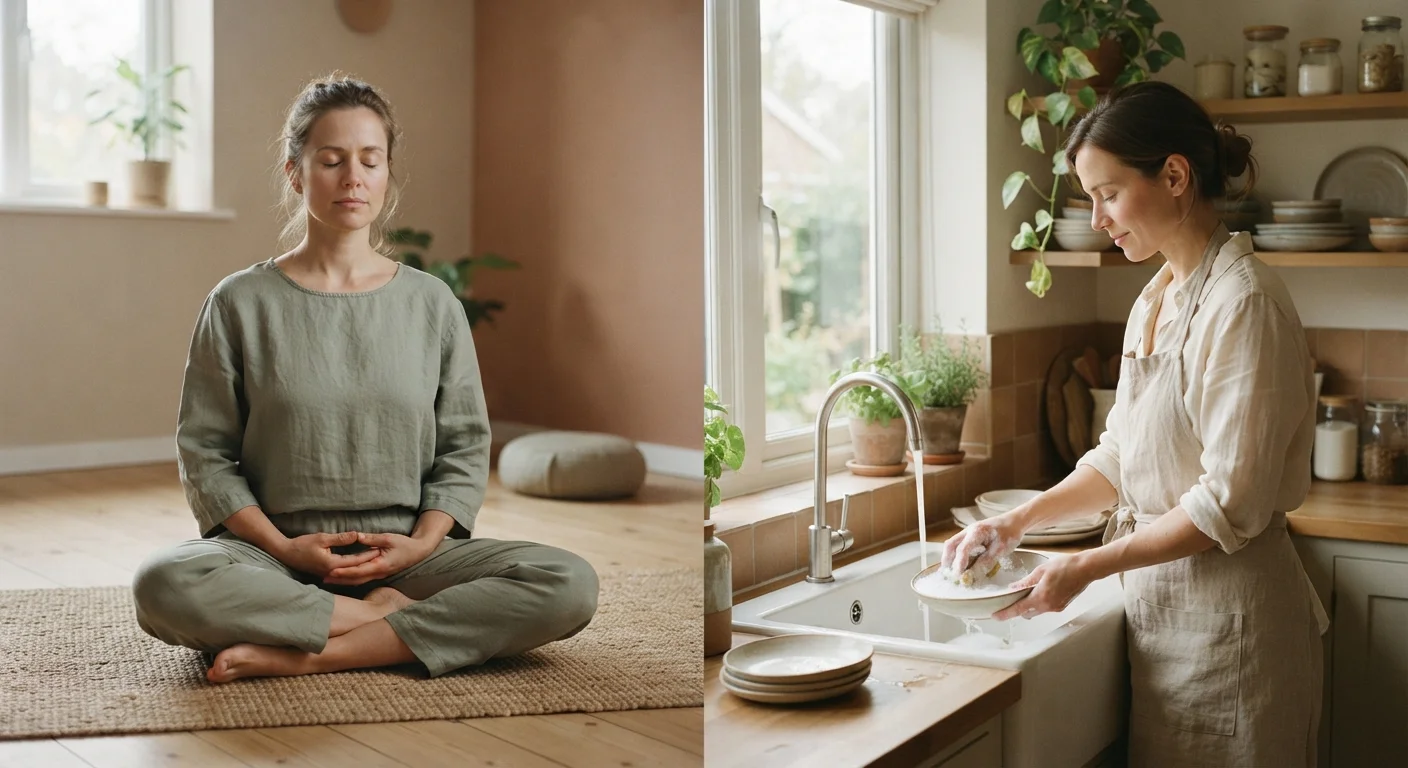
Mindfulness is a mental quality - the ability to pay deliberate, non-judgmental attention to the present moment. It doesn't require a cushion, a timer, or silence. You can practice mindfulness while eating, walking, or having a conversation, simply by focusing on what's happening right now instead of running on autopilot.
Meditation, by contrast, is a formal practice - a set of techniques performed deliberately, usually for a defined period. Common forms include focused attention (concentrating on the breath), open monitoring (observing thoughts without attachment), and loving-kindness practices. Many styles of meditation are specifically designed to cultivate mindfulness, but meditation can also pursue other goals, such as relaxation, compassion, or visualization.
A useful way to think about it: mindfulness is a destination; meditation is often one vehicle for getting there. You can arrive at mindful awareness through meditation - or through other intentional habits that anchor your attention to the present.
How the Research Compares
Both practices have attracted substantial scientific attention, though the quality and scope of evidence varies.
~14%
U.S. adults who have tried meditation
According to a National Center for Health Statistics survey, the share of American adults reporting meditation use roughly tripled between 2012 and 2017.
8 weeks
Standard MBSR program length
The Mindfulness-Based Stress Reduction protocol developed at UMass Medical School uses an eight-week structured curriculum as the basis for most clinical research.
47%
Of waking hours spent mind-wandering
A Harvard study using experience-sampling found that people's minds wander nearly half their waking hours, highlighting why present-moment training attracts research interest.
Mindfulness-Based Stress Reduction (MBSR), an eight-week structured program developed at the University of Massachusetts Medical School, has been studied extensively. Reviews published in peer-reviewed journals suggest MBSR may support reductions in perceived stress and improvements in well-being, though researchers note that study quality is uneven and individual outcomes vary considerably.
Meditation research faces similar methodological challenges - small sample sizes, self-reported outcomes, and difficulty designing placebo controls. That said, a meaningful body of work points to potential benefits for attention, emotional regulation, and sleep quality. The American Psychological Association recognizes mindfulness-based approaches as having a promising evidence base for certain conditions, particularly stress and anxiety, while emphasizing that more rigorous trials are needed.
Neither practice is a cure-all, and neither should be positioned as a substitute for professional mental health care. If you're navigating a diagnosed condition, see how therapy, counseling, and psychiatry differ before deciding whether to add mindfulness or meditation as a complementary tool.
Side-by-Side: Key Differences at a Glance
The table below contrasts the two practices across practical dimensions to help you quickly assess which aligns better with your habits and goals.
| Criterion | Mindfulness | Meditation |
|---|---|---|
| What it is | A quality of present-moment attention | A structured mental training practice |
| When practiced | Anytime, woven into daily activities | During a dedicated, scheduled session |
| Time required | No fixed duration needed | Typically 5-30 minutes per session |
| Learning curve | Low - can begin immediately | Moderate - technique benefits from guidance |
| Primary goal | Reduce autopilot; increase present awareness | Train attention, calm, or emotional regulation |
| Evidence base | Strong for MBSR-style programs | Growing; varies by meditation style and outcome |
| Tools needed | None | Optional: apps, audio guides, cushion, timer |
These distinctions are not rigid. Many people find that a brief daily meditation session spills naturally into more mindful awareness throughout the rest of their day - and that's a well-documented pattern in the research.
Choosing What Fits Your Life
The most effective practice is the one you'll actually maintain. A few questions can help clarify your starting point:
- Do you have five to twenty minutes you can set aside daily? If yes, a simple meditation practice - even guided breathing - is feasible. If not, informal mindfulness may be a more realistic fit.
- Do you prefer structure or flexibility? Meditation offers clear technique and measurable habit-tracking. Mindfulness is fluid and can adapt to any environment.
- What's your goal? Stress relief in the moment tends to respond well to mindfulness practices. Building longer-term attentional capacity often benefits from consistent formal meditation.
Digital tools - apps, audio guides, and online programs - can support both approaches. The tradeoffs of using apps for mental well-being support offers a balanced look at what these tools can and can't realistically provide before you commit to one.
If you're already engaged in a broader fitness or movement practice, it's worth noting that body-awareness exercises - like yoga or intentional stretching - can also cultivate present-moment attention. Flexibility, mobility, and stretching covers related concepts that sometimes intersect with mindfulness-based movement.
This article is for general informational purposes only and is not a substitute for professional mental health advice, diagnosis, or treatment. If you are experiencing significant mental health challenges, please consult a qualified healthcare professional.