

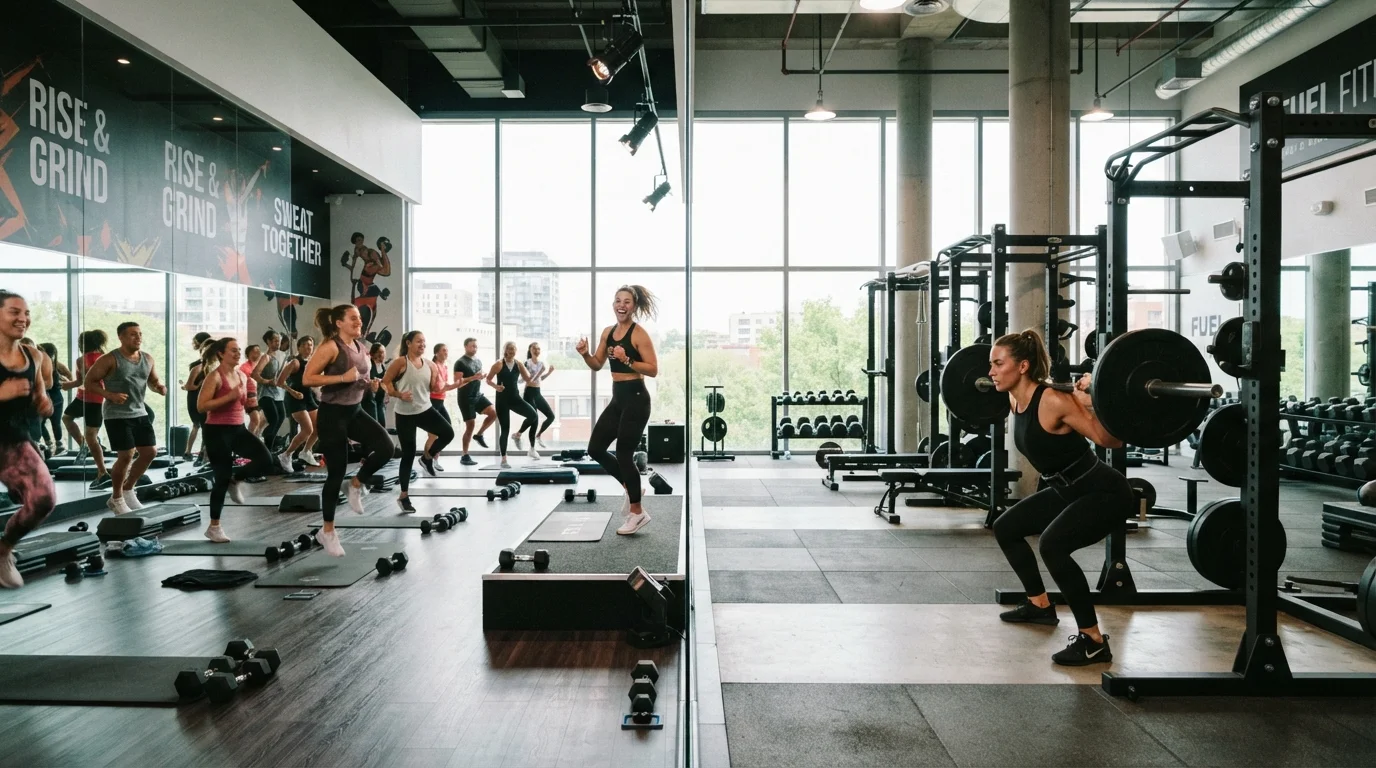
Key Takeaways
- Group fitness classes provide built-in accountability and social energy that can boost consistency.
- Solo training offers full flexibility and customization, allowing workouts to match individual goals precisely.
- Research suggests social exercise environments can increase workout frequency for many people.
- Neither approach is universally superior - personality, goals, and lifestyle all shape which works best.
- Combining both formats is a practical strategy that many exercisers find sustainable long-term.
Option A
Group Fitness Classes
The socially energized, instructor-led workout experience.
Best for: People who thrive on community motivation, structured routines, and scheduled accountability.
Option B
Solo Training
The self-directed, flexible approach to personal fitness.
Best for: People who prefer complete control over their schedule, intensity, and programming.
If you struggle with motivation and need external accountability
Group Fitness Classes
Scheduled classes with an instructor and peers create a social contract that makes skipping harder. The group energy can carry you through tough moments.
If you have specific performance or body-composition goals
Solo Training
Individualized programming - load, volume, rest periods - is far easier to manage and progress when you're not following a class format designed for general fitness.
If you're new to exercise and unsure where to start
Group Fitness Classes
An instructor guides form and pacing in real time, reducing the risk of injury and the overwhelm of building a routine from scratch.
If you have an unpredictable schedule or prefer training at odd hours
Solo Training
Without fixed class times, you can train whenever fits your day - a significant practical advantage for busy or shift-working adults.
If you want the benefits of both structure and flexibility
Group Fitness Classes
Using group classes for 1-2 sessions weekly while self-directing the rest blends social motivation with personal programming control.
The Case for Group Fitness Classes
Group fitness classes - from cycling and HIIT to yoga and dance cardio - work largely through social dynamics. When others around you are pushing hard, most people naturally match that energy. This effect, sometimes called the Köhler effect in exercise psychology research, suggests that individuals tend to work harder in group settings, particularly when paired with others who are slightly more capable.
Scheduled classes also impose structure. If your class starts at 6:30 a.m. on Tuesday, that time is claimed. For people who find it easy to rationalize skipping a self-planned workout, this built-in commitment is a meaningful advantage. A qualified instructor also cues proper form and adjusts intensity in real time - valuable especially for beginners navigating unfamiliar movements.
Social connection is another underappreciated benefit. Regular attendees often build community ties that make exercise feel less like a chore. If social connection matters to you in fitness, see how building a weekly workout schedule can incorporate group sessions strategically.
~95%
Higher class completion rate in groups
A study published in the Journal of the American Osteopathic Association found participants in group exercise reported significantly lower stress and higher quality of life compared to solo exercisers over a 12-week period.
2-3x
More likely to meet exercise goals with accountability
Research in behavioral science consistently shows that external accountability - such as a scheduled class or workout partner - substantially increases the likelihood of following through on planned exercise.
The Case for Solo Training
Solo training puts you in full control - of the exercises, the tempo, the rest intervals, and the overall program design. For anyone working toward a specific goal (building strength, improving endurance, rehabilitation from injury), that precision matters enormously. A general group class rarely aligns perfectly with an individual's progressive overload needs or movement restrictions.
Flexibility is equally compelling. Solo training happens on your schedule, not the gym's calendar. You're also free to pivot mid-workout: if your knee is bothering you, you substitute a movement without disrupting an instructor's plan or feeling self-conscious.
Introversion is a legitimate factor, too. Many people find group environments draining rather than energizing. For them, solo training isn't a compromise - it's the preferred environment for genuine focus. If you're exploring what types of effort feel most natural to you, understanding the difference between aerobic and anaerobic exercise can help you design sessions around your actual physiology.
One honest drawback: without external structure, solo training demands more self-discipline and programming knowledge. Without a sound plan, many solo exercisers plateau or develop imbalanced routines. This is where common fitness myths - like believing more is always better - can quietly derail progress.
Head-to-Head: Key Differences at a Glance
Both approaches have genuine merit. The comparison below captures their most practical distinctions to help you weigh which environment fits your life right now.
| Criterion | Group Fitness Classes | Solo Training |
|---|---|---|
| Accountability | High - scheduled, social commitment | Self-generated - requires discipline |
| Program Customization | Limited - class format is fixed | Full - tailored to personal goals |
| Schedule Flexibility | Lower - bound to class times | High - train anytime, anywhere |
| Instruction & Form Coaching | Available from instructor in real time | Self-monitored or learned independently |
| Social Connection | Naturally built into the format | Minimal unless actively sought |
| Cost | Often higher (studio fees, memberships) | Variable - can be very low cost |
| Progression Tracking | Difficult - class sets the pace | Straightforward - you control variables |
Worth noting: these factors aren't fixed. Many exercisers cycle between both formats depending on season, life demands, or shifting goals. If you're building a bodyweight-based home routine, solo training becomes especially practical - explore building real fitness with bodyweight training as a complementary approach.
This article provides general health and fitness information only and is not a substitute for personalized advice from a qualified fitness professional or healthcare provider. Consult a professional before beginning any new exercise program, especially if you have an existing health condition or injury.